





Calculation of beyond visual range air combat all-domain fire field and application of situation threat assessment and assistant decision making
-
摘要:
针对超视距(BVR)空战态势威胁评估问题,提出一种基于全域火力场的空战态势威胁评估方法,基于超视距空战载机、设备特征,开展离线单机全域火力场数值计算和在线多机聚合全域火力场计算,克服了传统态势威胁评估方法主观性强、不满足实时计算需求等缺陷。考虑导弹导引头探测误差及导弹舵机响应时延,建立超视距空战仿真环境;考虑飞行员操纵行为偏差,划分机动动作关键决策点并引入正态分布的关键决策点控制量散布,基于蒙特卡罗法,统计载机空战胜率,离线计算单机全域火力场;基于独立概率事件假设在线计算多机聚合全域火力场;计算全域火力场的梯度特征表征模型,并针对一对一超视距空战场景,设计辅助决策系统。实验计算结果有效验证了全域火力场的概念设计和计算方法,为基于全域火力场的超视距空战态势威胁评估和辅助决策系统设计提供了支撑。
Abstract:This paper proposes a calculation method for the all-domain fire field for the threat assessment of beyond visual range (BVR) air combat situations. To overcome the drawbacks of conventional situation threat assessment techniques, such as high subjectivity and an inability to meet real-time computing requirements, the all-domain fire field calculation is split into offline single aircraft fire field calculation and online aggregation calculation, taking into account the limitations of missile-based computing resources. Firstly, a BVR air combat simulation environment was established, taking into account the detection error of missile seekers and the delay of servo response. Secondly, based on the Monte Carlo method, considering the deviation of pilot behavior, key decision points for maneuver are divided and control variables with normal distribution are introduced to calculate the success rate. Furthermore, based on the independent probability event formula, the single aircraft fire field is aggregated. Finally, calculate the gradient feature representation model of the entire fire field, and design a decision aiding system for one-on-one beyond visual range air combat scenarios. This work can confirm the all-domain firing field’s conceptual design and provide further evidence for the study of decision-assistance system design and threat assessment techniques for BVR air combat situations.
-
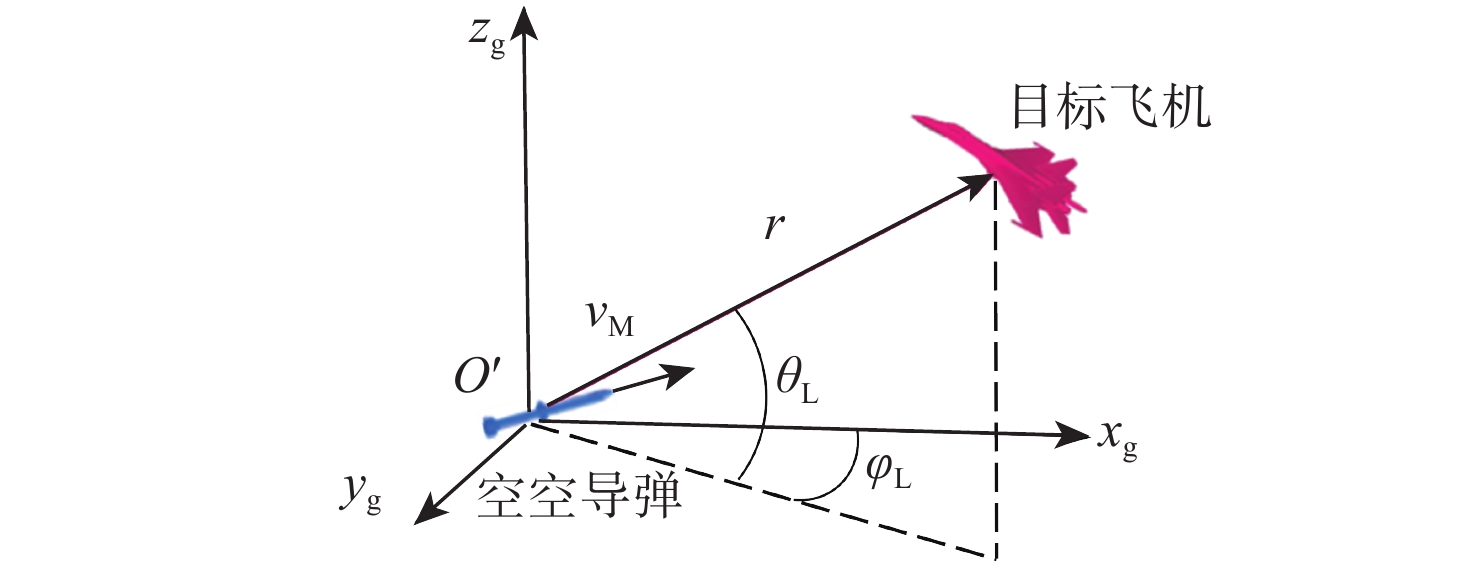
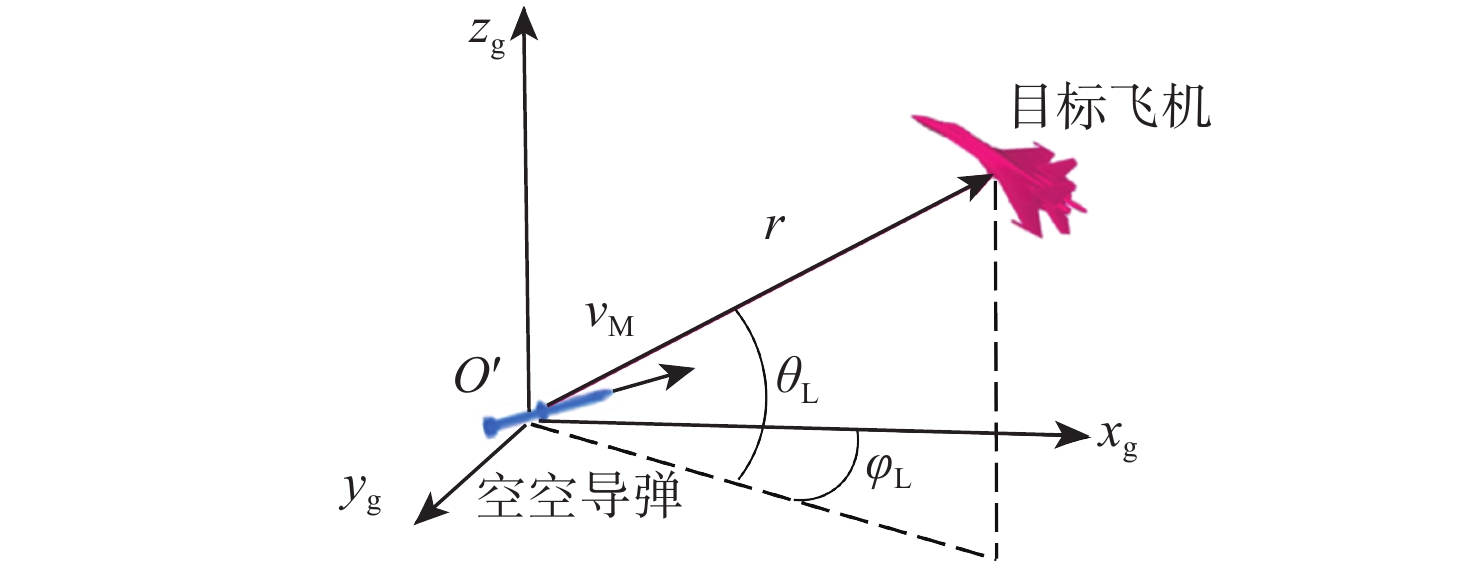
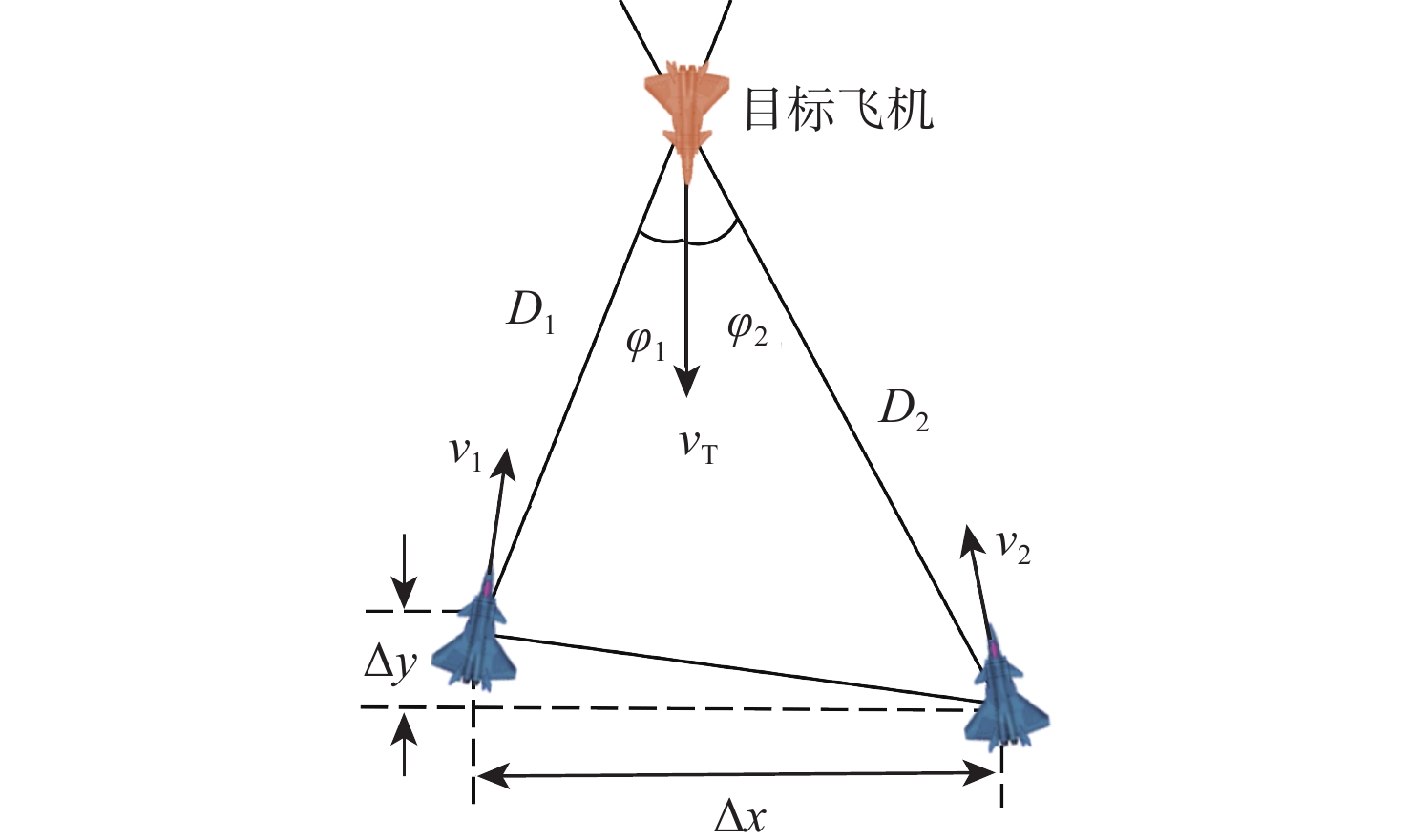
图 3 空空导弹和目标飞机相对位置示意图
Figure 3. Schematic of the relative position of the missile and the target
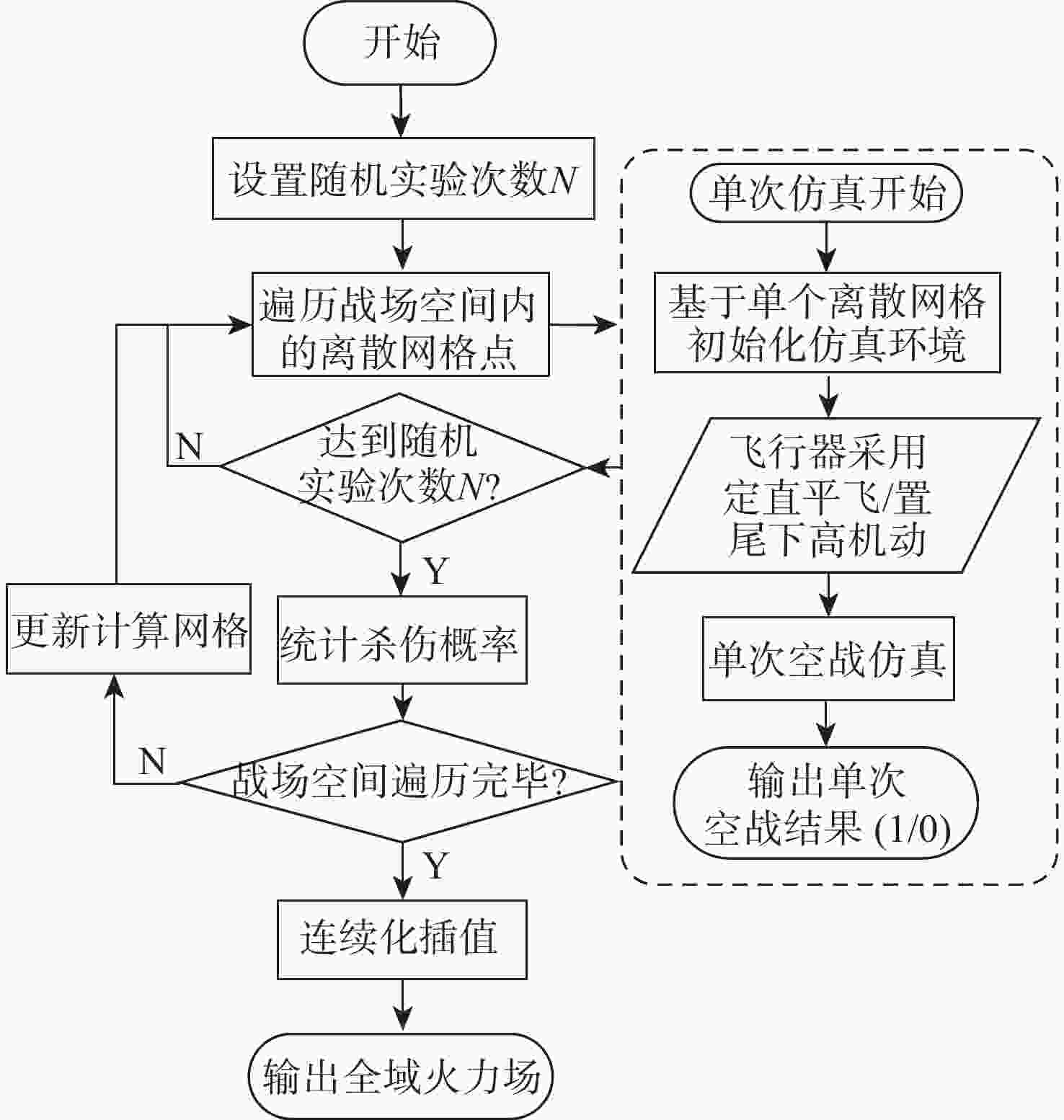
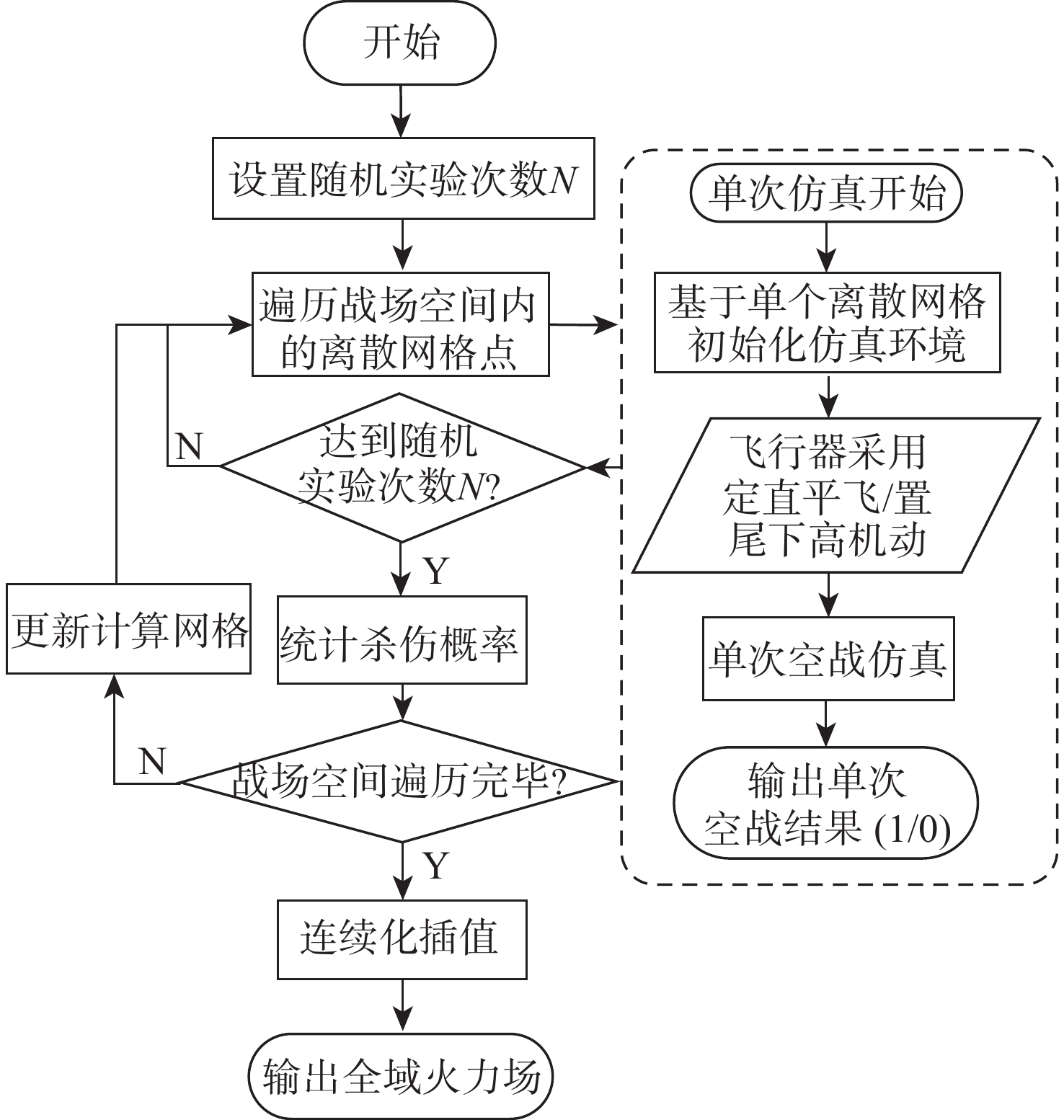
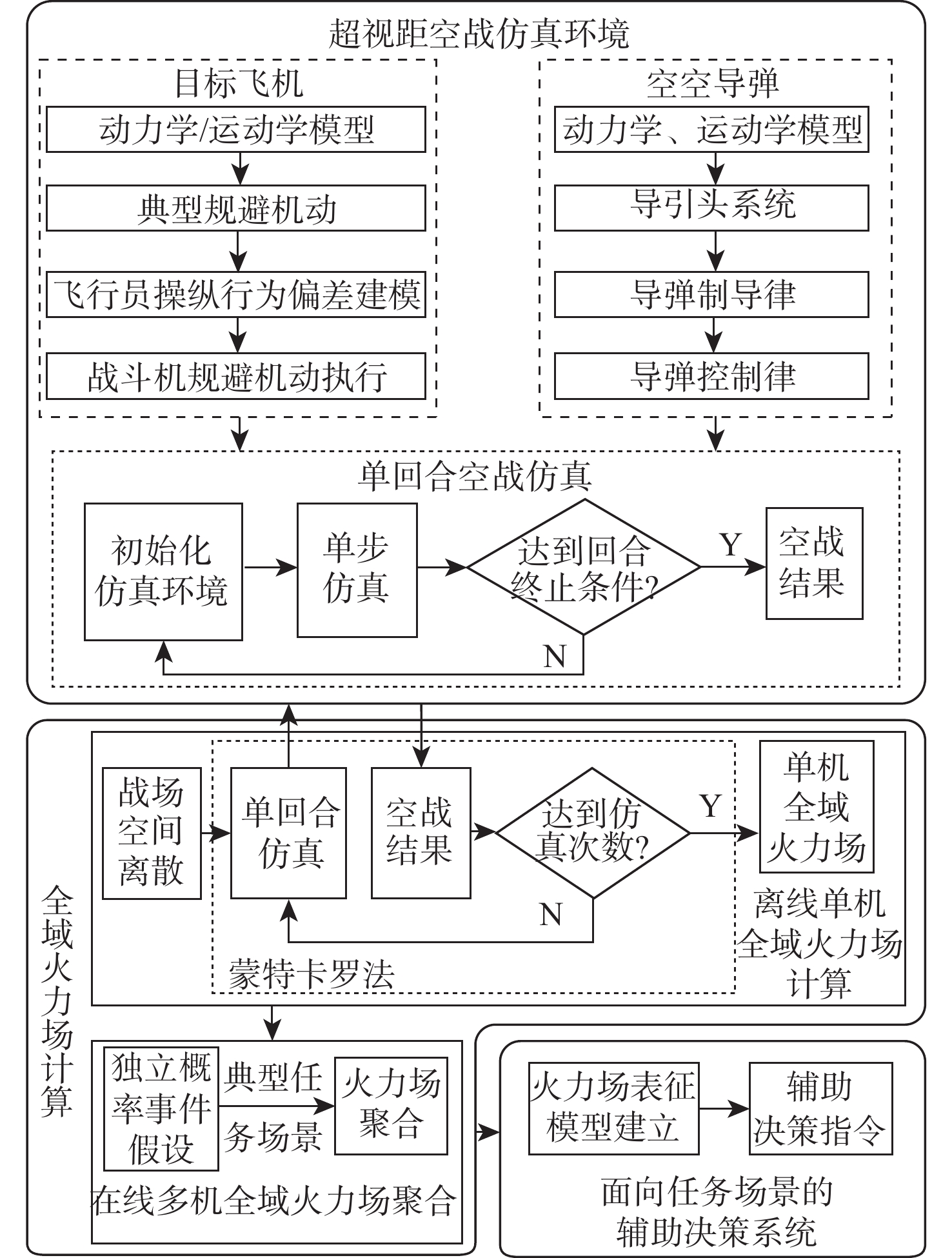
图 8 离线单机全域火力场计算流程
Figure 8. Calculation process for offline single aircraft all-domain fire field
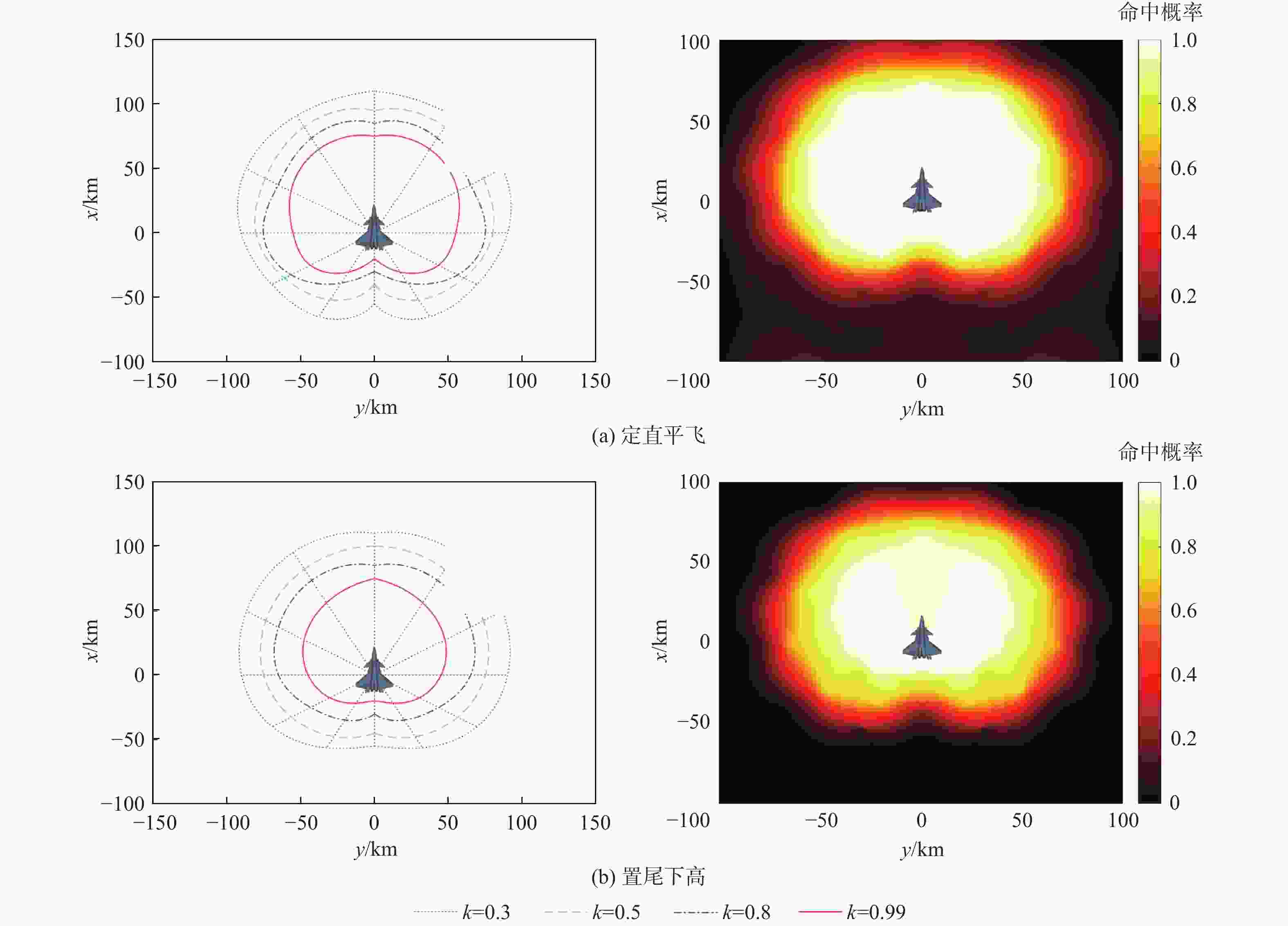
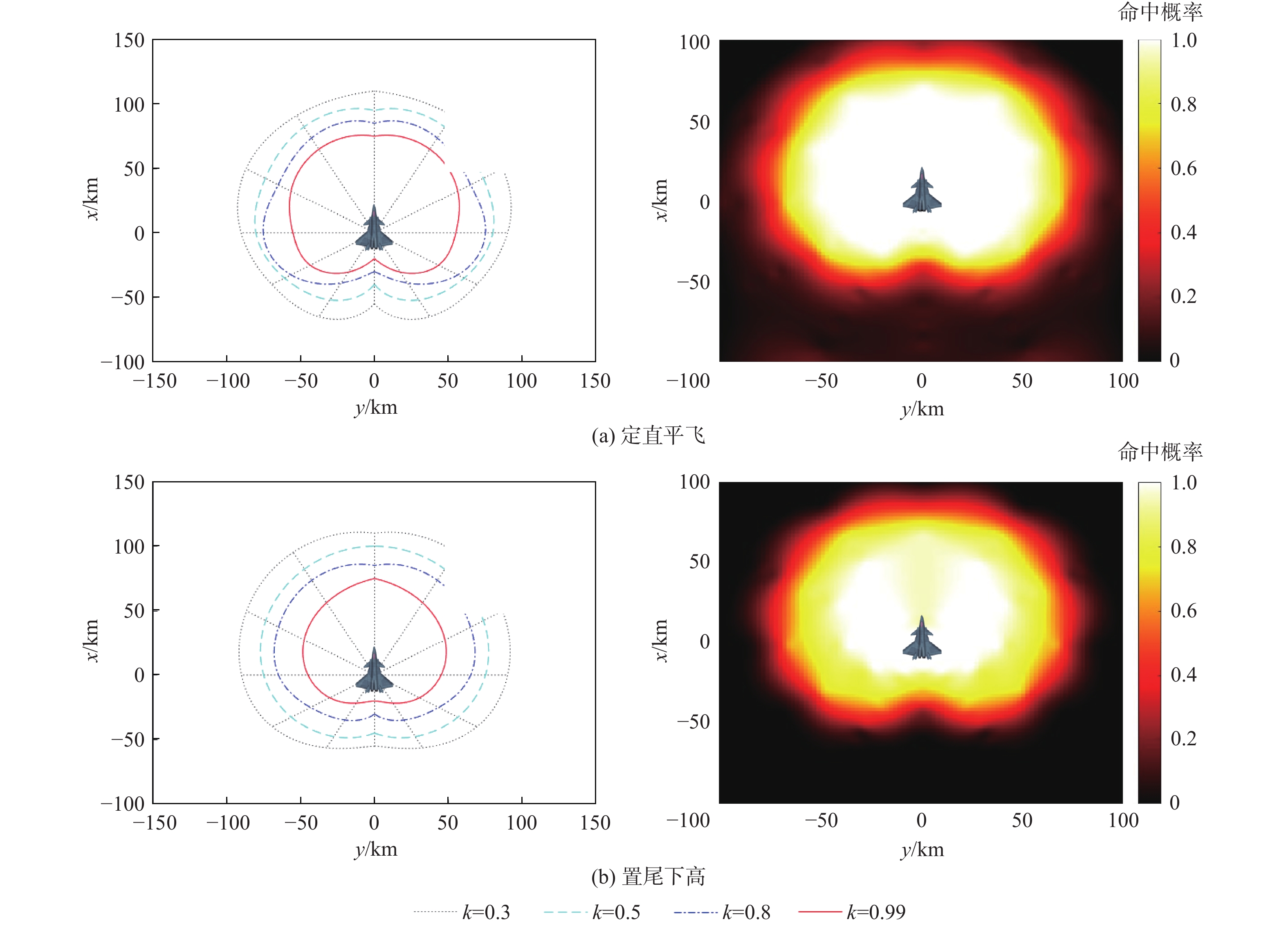
图 10 载机中心火控模式下的等杀伤概率包线图及热力图
Figure 10. Equivalent probability of destruction envelope diagram and heat map under the fire control mode of the airborne control centre
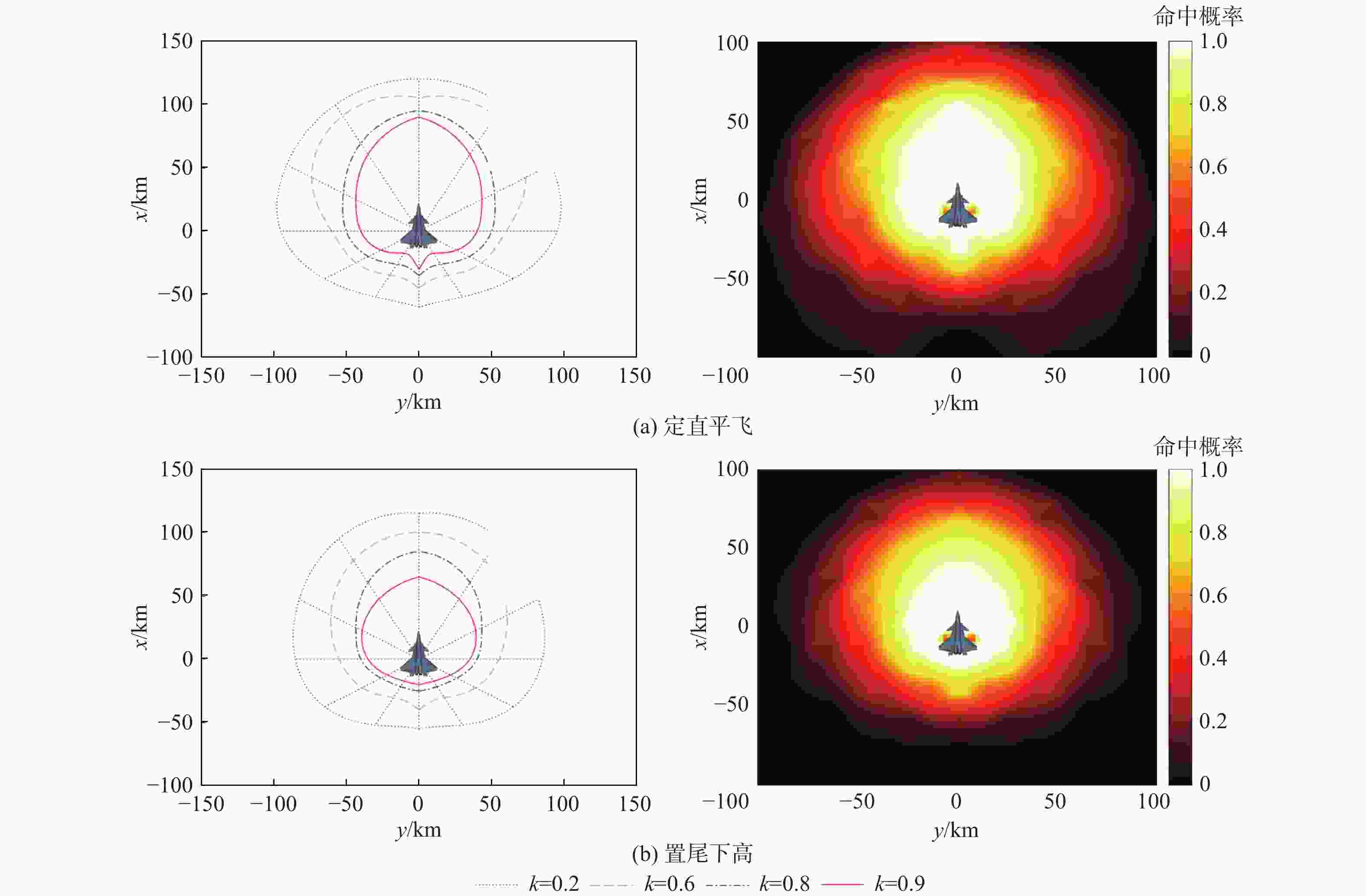
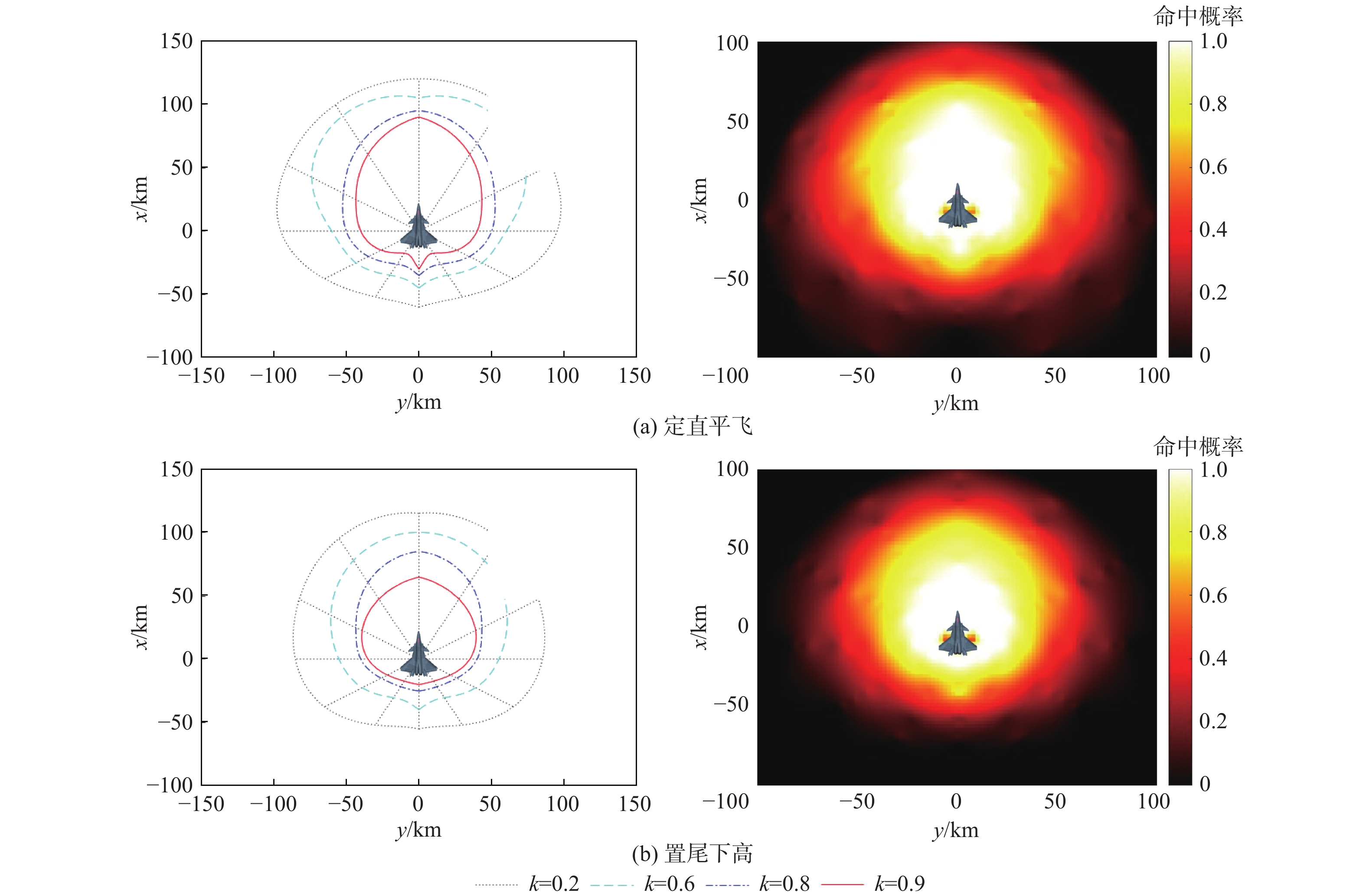
图 11 目标中心火控模式下的等杀伤概率包线图及热力图
Figure 11. Equivalent probability of destruction envelope diagram and heat map under the fire control mode of target centre
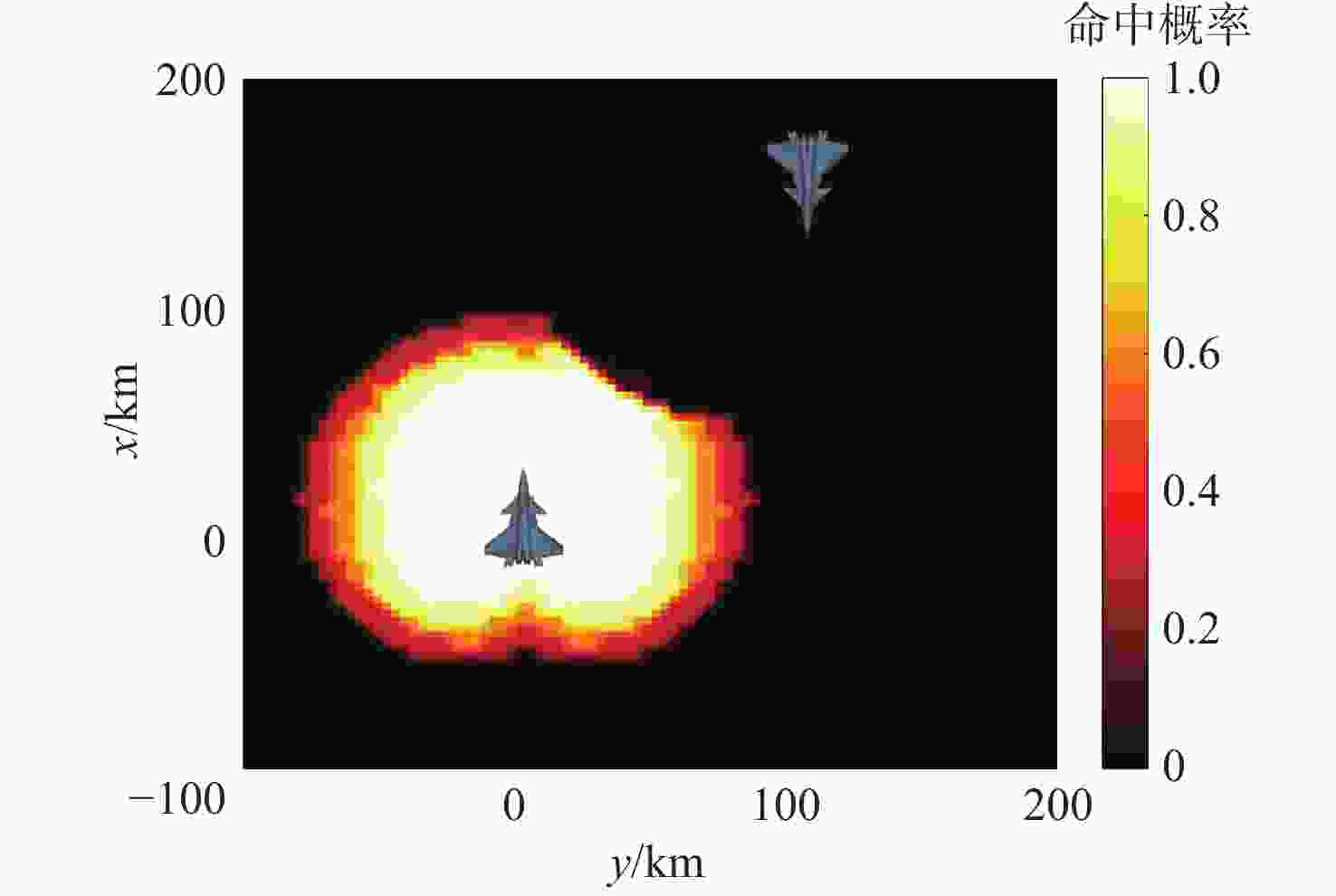
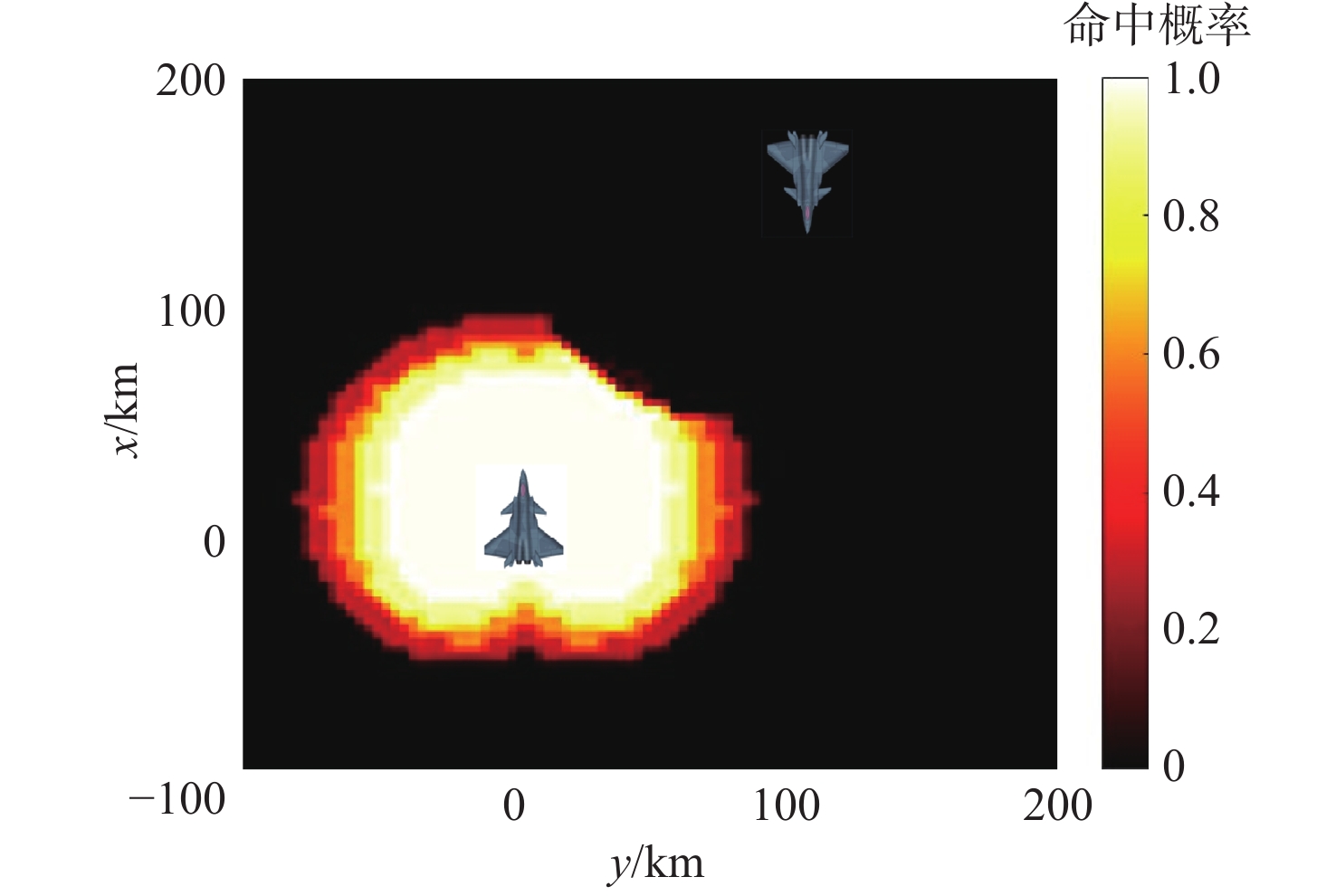
图 12 单机射前有目标火力场热力图
Figure 12. Schematic of heat map of the fire field with target before single aircraft shooting
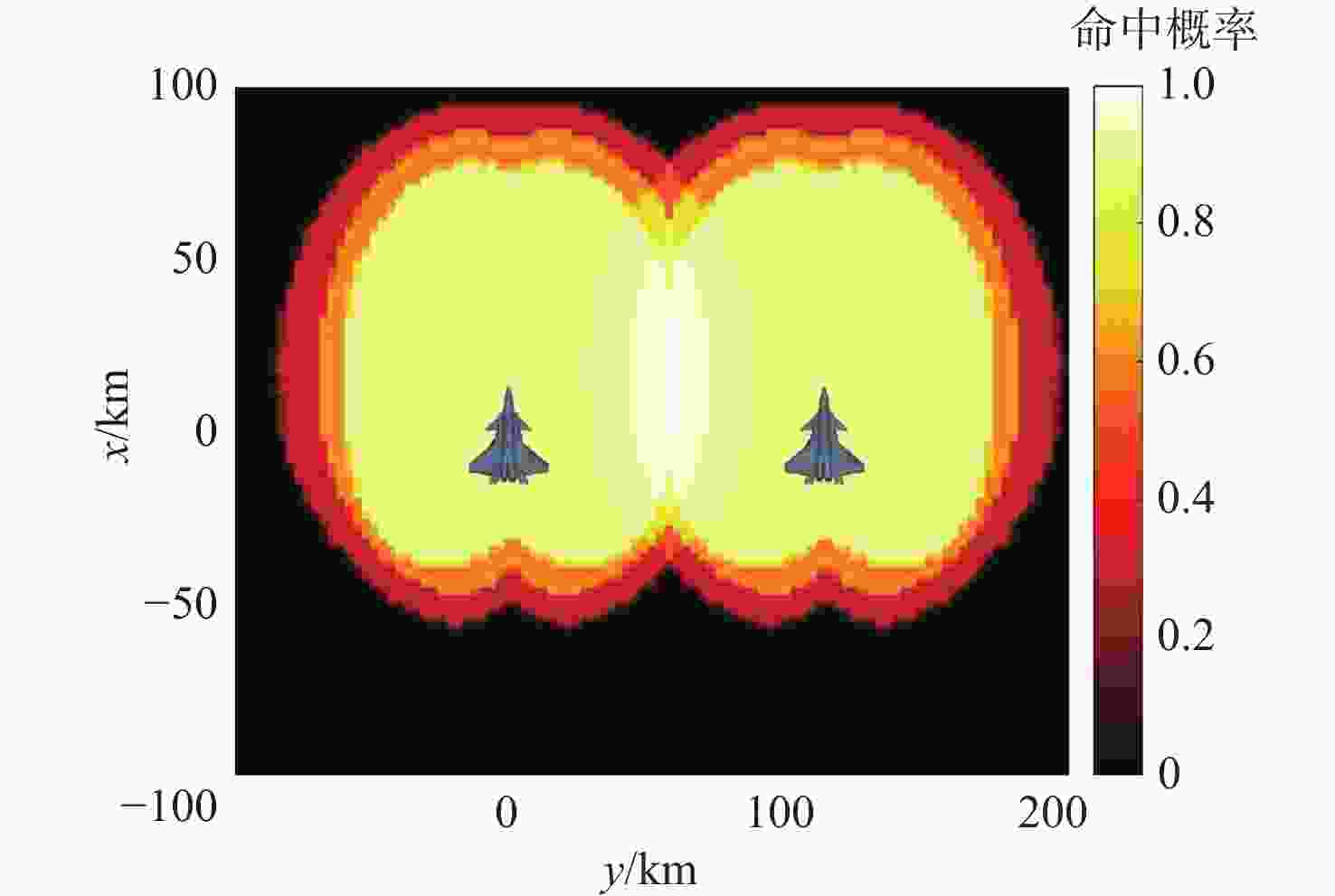
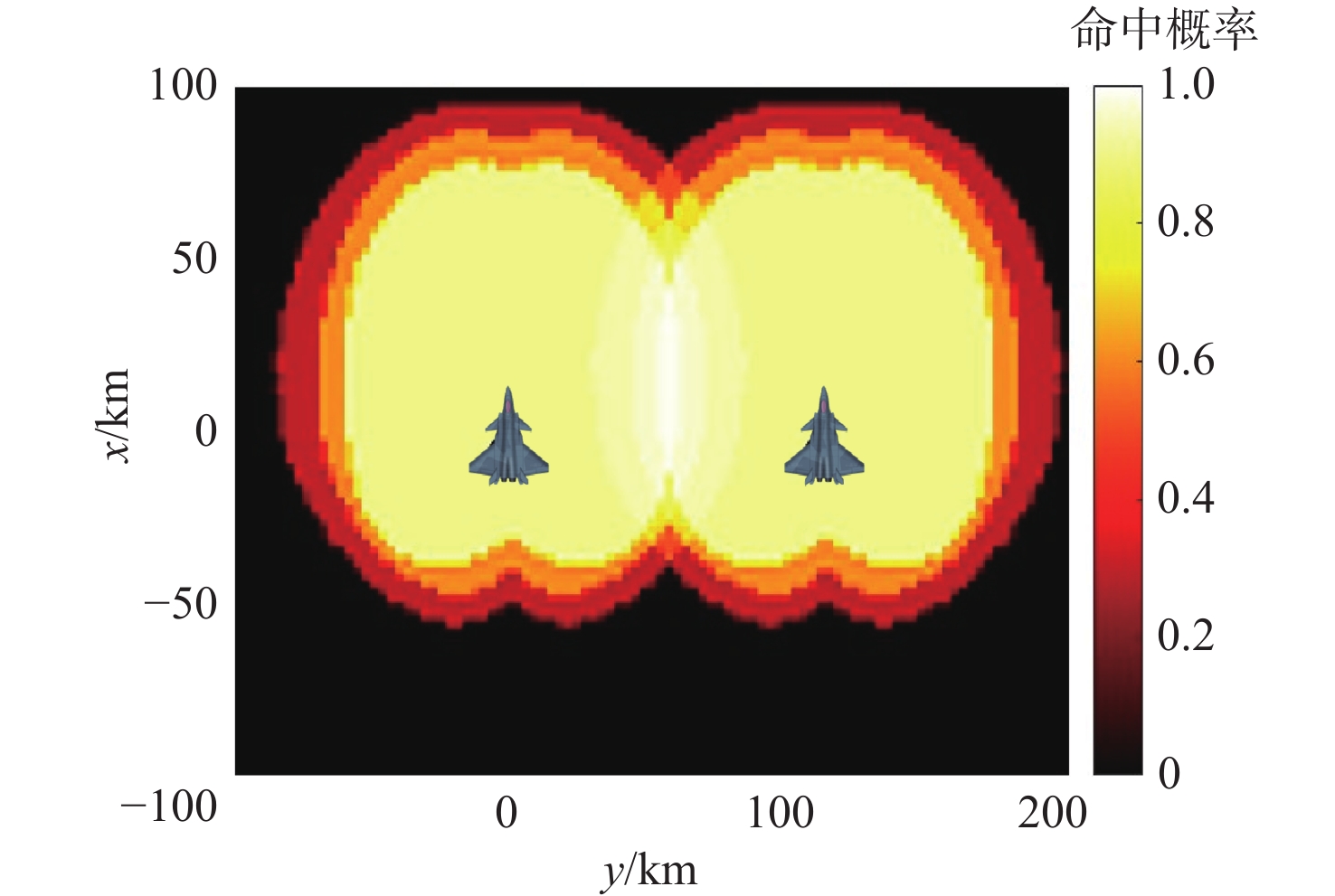
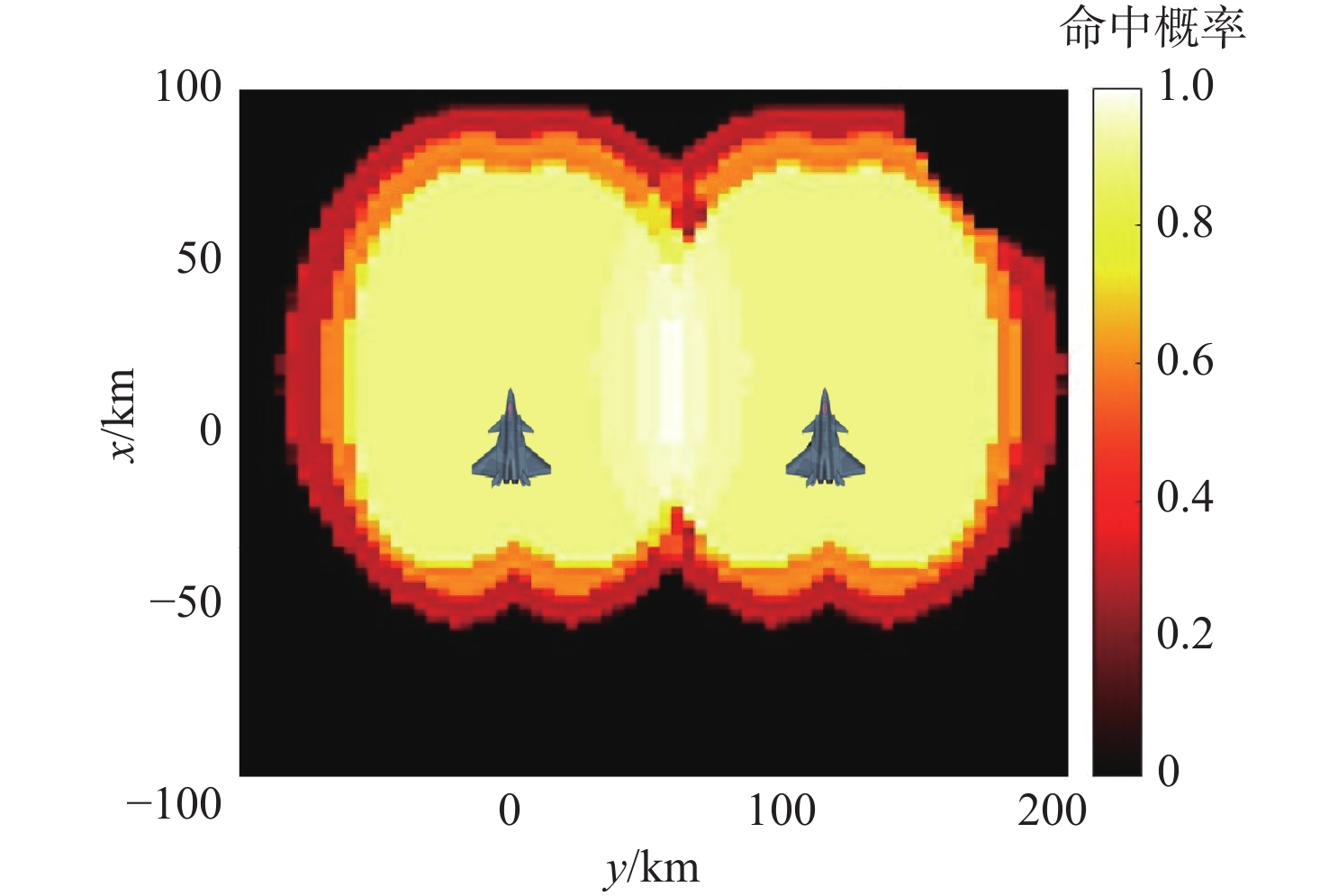
图 13 双机协同编队射前无目标火力场热力图
Figure 13. Heat map of dual-aircraft collaboration without target
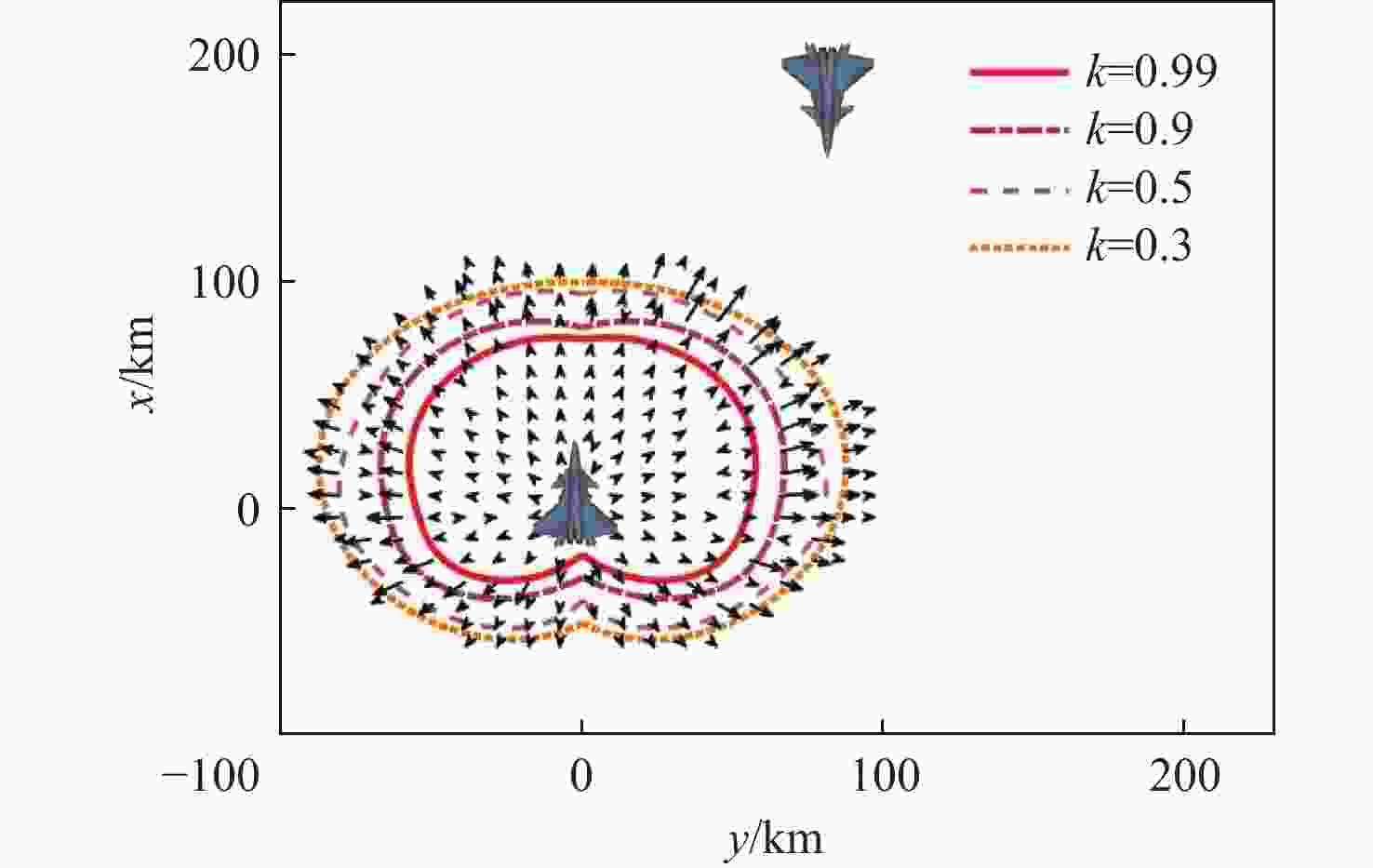
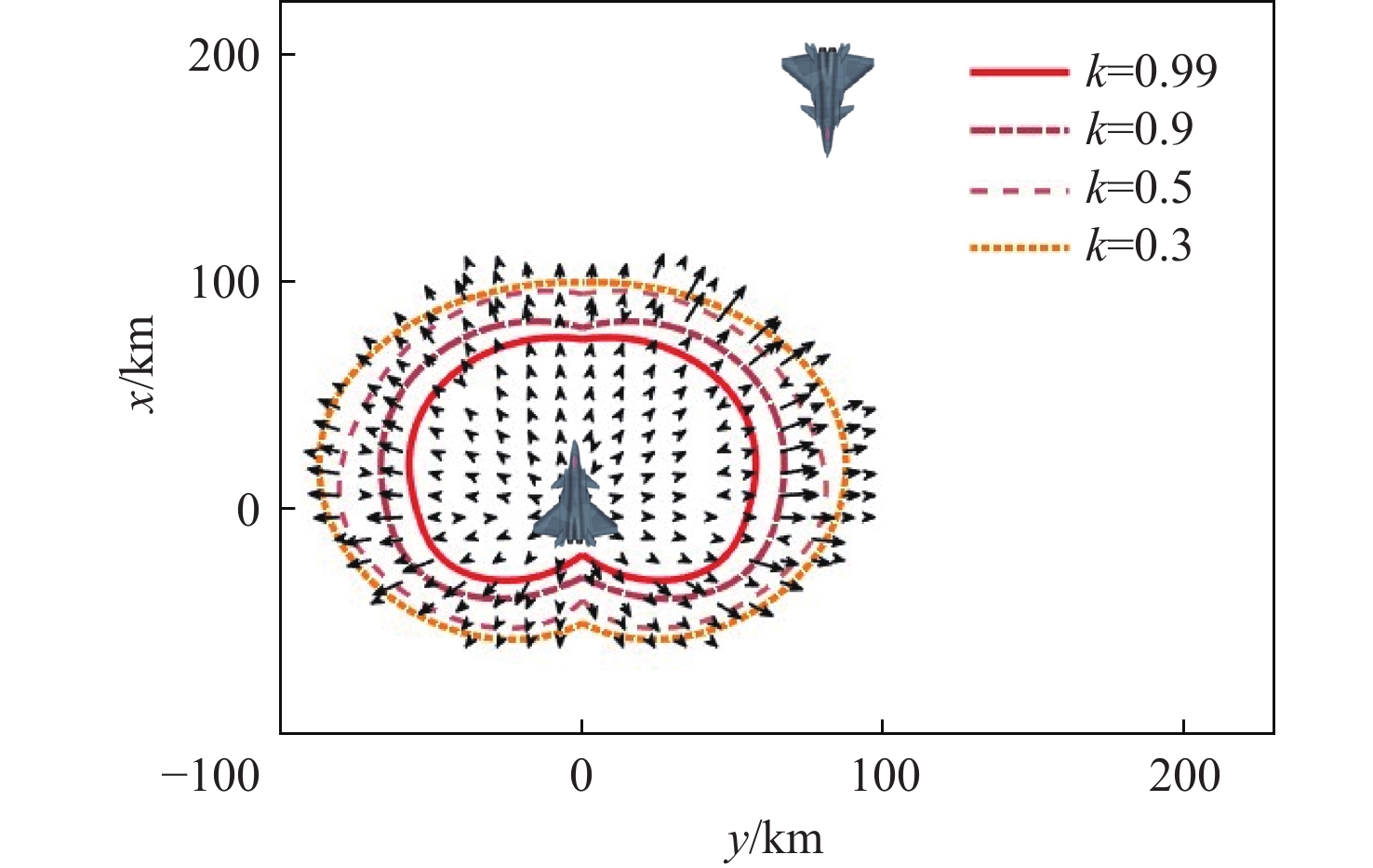
图 15 单机射前有目标火力场梯度分布
Figure 15. Gradient distribution of the fire field with target before single aircraft shooting
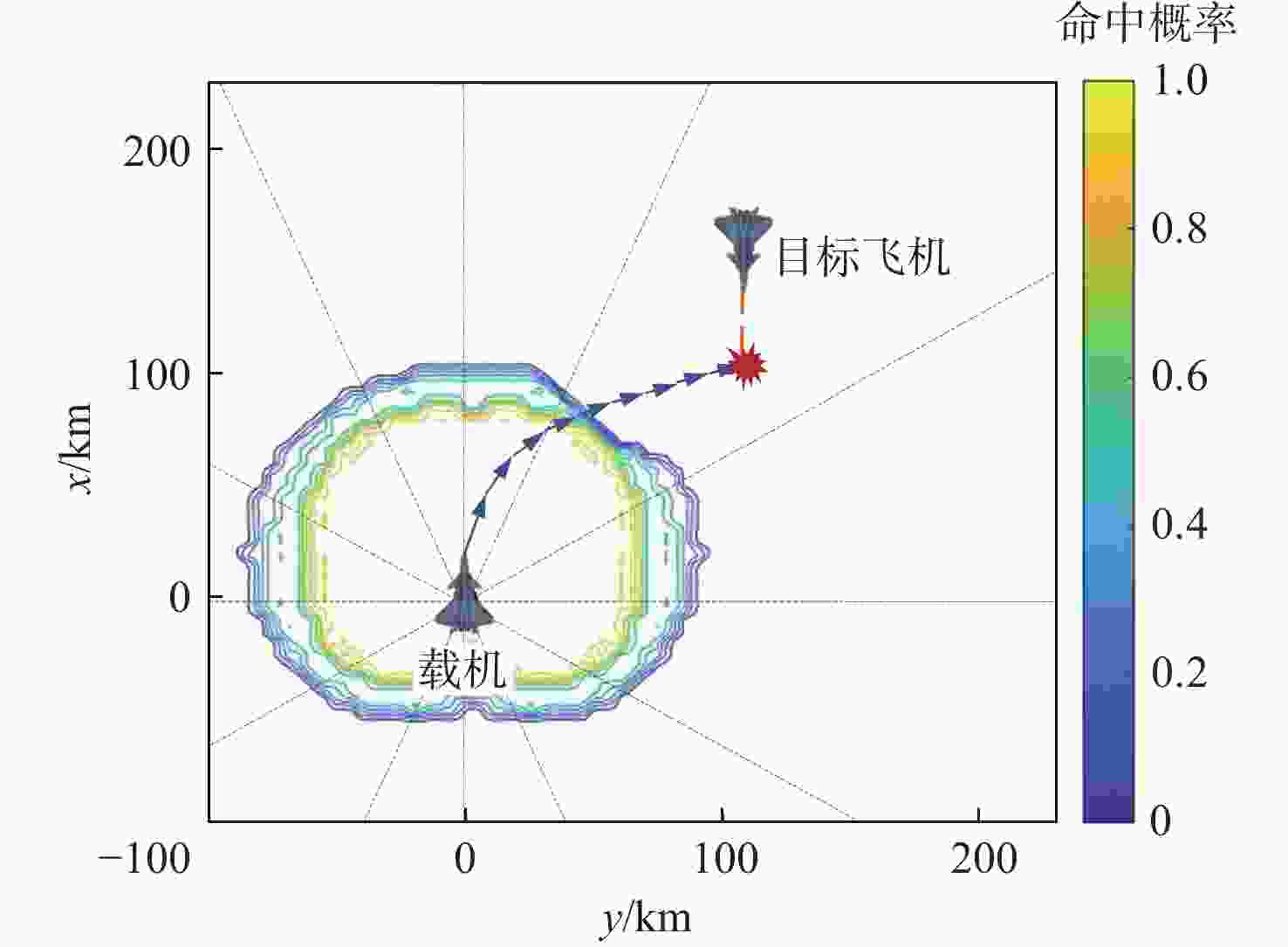
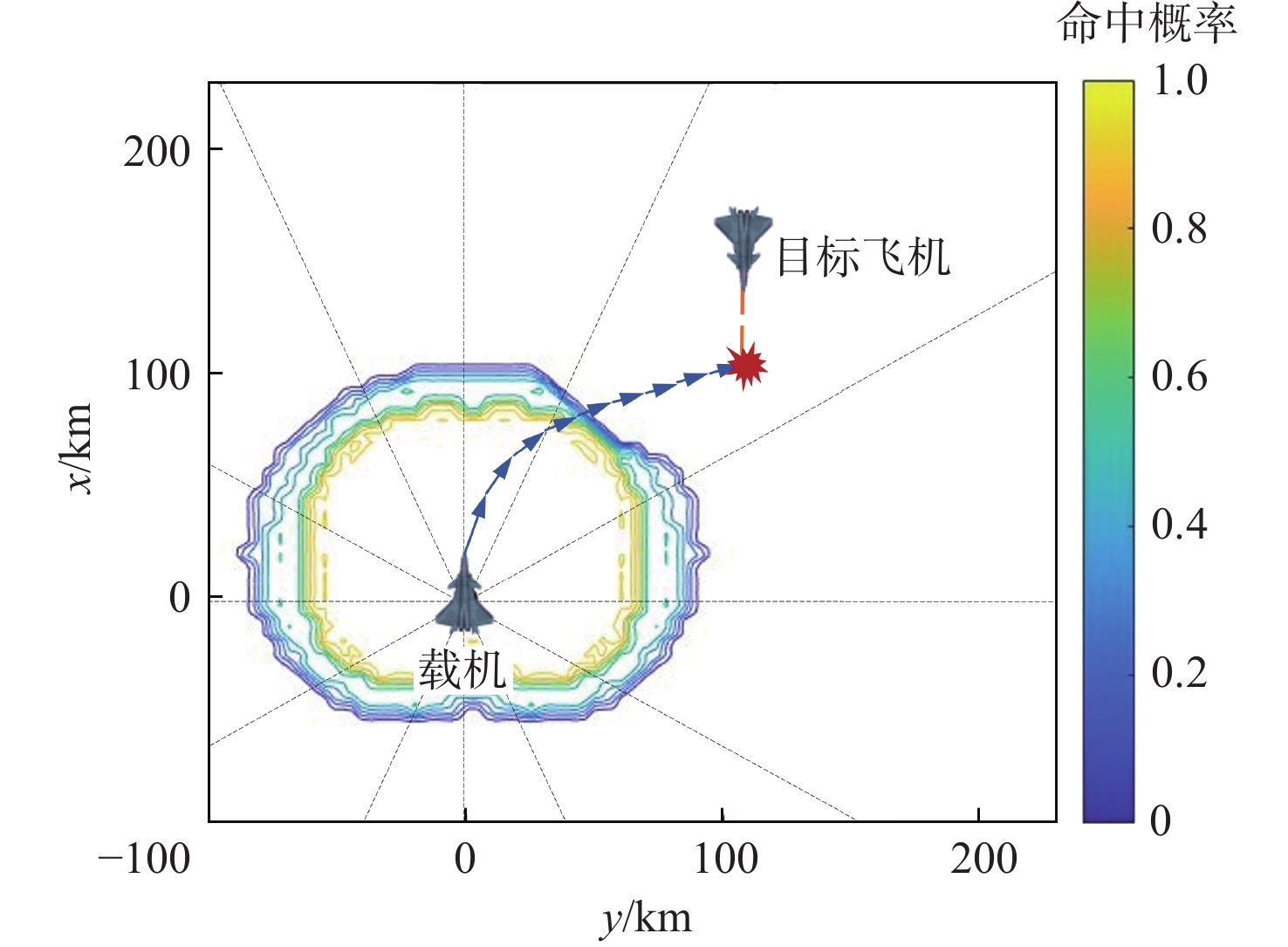
图 16 面向单机射前有目标场景的辅助决策示意图
Figure 16. Schematic of assisted decision-making for the scene with target before single aircraft shooting
表 1 截获目标或脱锁条件
Table 1. Intercepts target or unlocks conditions
满足条件 表达式 导引头打开条件 $ r\leqslant {D}_{\max } $ 导引头视场条件 $ \omega \geqslant {\varphi }_{\mathrm{T}\mathrm{M}}+\Delta \omega $ 导引头连续锁定时间条件 $ {\tau }_{1}\geqslant {\tau }_{\text{sd}} $ 导弹导引头脱锁时间条件 $ {\tau }_{2}\geqslant {\tau }_{\text{ts}} $  下载: 导出CSV
表 2 导弹误差参数设置
Table 2. Missile error parameter settings
舵机响应时延/s 导引头测角误差/(°) 导引头测距误差/m 1 0~5 0~10
下载: 导出CSV
-
[1] 杨伟. 关于未来战斗机发展的若干讨论[J]. 航空学报, 2020, 41(6): 524377.YANG W. Development of future fighters[J]. Acta Aeronautica et Astronautica Sinica, 2020, 41(6): 524377(in Chinese). [2] 谢岚风, 陈军, 焦璐, 等. 未来空战全域火力场研究[J]. 航空学报, 2024, 45(5): 529699. doi: 10.7527/S1000-6893.2024.29699XIE L F, CHEN J, JIAO L, et al. All-domain fire field in future air combat[J]. Acta Aeronautica et Astronautica Sinica, 2024, 45(5): 529699(in Chinese). doi: 10.7527/S1000-6893.2024.29699 [3] 樊会涛. 空战制胜“四先”原则[J]. 航空兵器, 2013, 20(1): 3-7.FAN H T. Four “first” principles to win in air combat[J]. Aero Weaponry, 2013, 20(1): 3-7(in Chinese). [4] 肖亮, 黄俊, 徐钟书. 基于空域划分的超视距空战态势威胁评估[J]. 北京航空航天大学学报, 2013, 39(10): 1309-1313. doi: 10.13700/j.bh.1001-5965.2013.10.006XIAO L, HUANG J, XU Z S. Modeling air combat situation assessment based on combat area division[J]. Journal of Beijing University of Aeronautics and Astronautics, 2013, 39(10): 1309-1313(in Chinese). doi: 10.13700/j.bh.1001-5965.2013.10.006 [5] 张涛, 郭基联, 张淑丽, 等. 基于半监督朴素贝叶斯的空战态势评估[C]//2018中国自动化大会. 西安: 中国自动化学会, 2018: 323-329.ZHANG T, GUO J L, ZHANG S L, et al. Situation assessment for air combat based on semi-supervised-learning naive Bayes[C]//Proceedings of the CAC2018. Xi’an: Chinese Association of Automation, 2018: 323-329(in Chinese). [6] KUMAR S, TRIPATHI B K. Modelling of threat evaluation for dynamic targets using Bayesian network approach[J]. Procedia Technology, 2016, 24: 1268-1275. doi: 10.1016/j.protcy.2016.05.112 [7] XU X M, YANG R N, FU Y. Situation assessment for air combat based on novel semi-supervised naive Bayes[J]. Journal of Systems Engineering and Electronics, 2018, 29(4): 768-779. doi: 10.21629/JSEE.2018.04.11 [8] 佟海鹏, 刘晓静, 马延明. 基于灰关联分析的目标分级排序模型[J]. 火力与指挥控制, 2010, 35(12): 93-96. doi: 10.3969/j.issn.1002-0640.2010.12.027TONG H P, LIU X J, MA Y M. Classified sequencing model of target based on grey relation analysis[J]. Fire Control & Command Control, 2010, 35(12): 93-96(in Chinese). doi: 10.3969/j.issn.1002-0640.2010.12.027 [9] 张洪波, 李国英, 丁全心, 等. 超视距空战下的态势评估技术研究[J]. 电光与控制, 2010, 17(4): 9-13.ZHANG H B, LI G Y, DING Q X, et al. Research on situation assessment in BVR air combat[J]. Electronics Optics & Control, 2010, 17(4): 9-13(in Chinese). [10] 周思羽, 吴文海, 曲志刚, 等. 基于非参量法的空战态势评估分析[J]. 航空计算技术, 2011, 41(4): 13-16. doi: 10.3969/j.issn.1671-654X.2011.04.004ZHOU S Y, WU W H, QU Z G, et al. Analysis of air combat situation assessment based on nonparametric methods[J]. Aeronautical Computing Technique, 2011, 41(4): 13-16(in Chinese). doi: 10.3969/j.issn.1671-654X.2011.04.004 [11] LI H, LIU B L, SONG R Q. Air attack target threat assessment based on combination weighting[J]. International Journal of Advanced Network, Monitoring and Controls, 2022, 7(2): 92-99. doi: 10.2478/ijanmc-2022-0020 [12] 程天发, 葛泉波, 陈哨东, 等. 基于改进空战威胁评估模型的权重计算方法比较[J]. 火力与指挥控制, 2016, 41(1): 32-36. doi: 10.3969/j.issn.1002-0640.2016.01.008CHENG T F, GE Q B, CHEN S D, et al. Comparision on weights calculation methods based on improved air combat threat assessment model[J]. Fire Control & Command Control, 2016, 41(1): 32-36(in Chinese). doi: 10.3969/j.issn.1002-0640.2016.01.008 [13] 华家辉, 孙鑫, 陈晓东, 等. 基于集群分析的空中作战目标威胁评估技术研究[J]. 战术导弹技术, 2023(2): 96-104. doi: 10.16358/j.issn.1009-1300.20210238HUA J H, SUN X, CHEN X D, et al. Research on air objective threat assessment technology based on cluster analysis[J]. Tactical Missile Technology, 2023(2): 96-104(in Chinese). doi: 10.16358/j.issn.1009-1300.20210238 [14] 方伟, 方君, 徐涛, 等. 超视距空战仿真中的态势评估方法[J]. 计算机仿真, 2019, 36(10): 29-33. doi: 10.3969/j.issn.1006-9348.2019.10.007FANG W, FANG J, XU T, et al. Method of situation assessment in beyond visual range air combat simulation[J]. Computer Simulation, 2019, 36(10): 29-33(in Chinese). doi: 10.3969/j.issn.1006-9348.2019.10.007 [15] 兰轶冰, 王维嘉, 宋科璞. 基于导弹攻击区的空战战术决策方法研究[J]. 电光与控制, 2020, 27(10): 8-11. doi: 10.3969/j.issn.1671-637X.2020.10.002LAN Y B, WANG W J, SONG K P. Air combat tactical decision-making based on missile attack envelop[J]. Electronics Optics & Control, 2020, 27(10): 8-11(in Chinese). doi: 10.3969/j.issn.1671-637X.2020.10.002 [16] 杨爱武, 李战武, 李宝, 等. 基于动态变权重的空战态势评估[J]. 兵工学报, 2021, 42(7): 1553-1563. doi: 10.3969/j.issn.1000-1093.2021.07.023YANG A W, LI Z W, LI B, et al. Air combat situation assessment based on dynamic variable weight[J]. Acta Armamentarii, 2021, 42(7): 1553-1563(in Chinese). doi: 10.3969/j.issn.1000-1093.2021.07.023 [17] 翟翔宇. 基于全连接神经网络的空战目标威胁评估方法研究[D]. 太原: 中北大学, 2020.ZHAI X Y. Research on threat assessment method of air combat target based on fully connected neural network[D]. Taiyuan: North University of China, 2020(in Chinese). [18] 朱丰, 胡晓峰, 吴琳, 等. 基于深度学习的战场态势高级理解模拟方法[J]. 火力与指挥控制, 2018, 43(8): 25-30.ZHU F, HU X F, WU L, et al. Simulation method of battlefields situation senior comprehension based on deep learning[J]. Fire Control & Command Control, 2018, 43(8): 25-30(in Chinese). [19] XU X M, YANG R N, YU Y. Threat assessment in air combat based on ELM neural network[C]//Proceedings of the 2019 IEEE International Conference on Artificial Intelligence and Computer Applications. Piscataway: IEEE Press, 2019: 114-120. [20] TAN K W, YAN W J, ZHANG L M, et al. Semi-supervised specific emitter identification based on bispectrum feature extraction CGAN in multiple communication scenarios[J]. IEEE Transactions on Aerospace and Electronic Systems, 2023, 59(1): 292-310. doi: 10.1109/TAES.2022.3184619 [21] 方伟, 张婷婷, 谭凯文, 等. 基于差分窗口生成式对抗网络的空战态势评估[J]. 系统工程与电子技术, 2024, 46(8): 2738-2746. doi: 10.12305/j.issn.1001-506X.2024.08.21FANG W, ZHANG T T, TAN K W, et al. Air combat situation assessment based on differential window generative adversarial network[J]. Systems Engineering and Electronics, 2024, 46(8): 2738-2746(in Chinese). doi: 10.12305/j.issn.1001-506X.2024.08.21 [22] 李银通, 韩统, 孙楚, 等. 基于逆强化学习的空战态势评估函数优化方法[J]. 火力与指挥控制, 2019, 44(8): 101-106. doi: 10.3969/j.issn.1002-0640.2019.08.019LI Y T, HAN T, SUN C, et al. An optimization method of air combat situation assessment function based on inverse reinforcement learning[J]. Fire Control & Command Control, 2019, 44(8): 101-106(in Chinese). doi: 10.3969/j.issn.1002-0640.2019.08.019 [23] 胡涛, 王栋, 姜龙亭, 等. 空战智能态势评估技术研究与展望[J]. 军事文摘, 2020(3): 18-22.HU T, WANG D, JIANG L T, et al. Research and prospect of intelligent situation assessment technology in air combat[J]. Military Digest, 2020(3): 18-22(in Chinese). [24] 张宏鹏, 黄长强, 轩永波, 等. 基于深度神经网络的无人作战飞机自主空战机动决策[J]. 兵工学报, 2020, 41(8): 1613-1622. doi: 10.3969/j.issn.1000-1093.2020.08.016ZHANG H P, HUANG C Q, XUAN Y B, et al. Maneuver decision of autonomous air combat of unmanned combat aerial vehicle based on deep neural network[J]. Acta Armamentarii, 2020, 41(8): 1613-1622(in Chinese). doi: 10.3969/j.issn.1000-1093.2020.08.016 [25] 常一哲, 李战武, 孙源源, 等. 基于威力场的超视距协同空战态势评估方法[J]. 火力与指挥控制, 2015, 40(10): 40-45. doi: 10.3969/j.issn.1002-0640.2015.10.010CHANG Y Z, LI Z W, SUN Y Y, et al. Situation assessment method for cooperative air combat based on combat power field[J]. Fire Control & Command Control, 2015, 40(10): 40-45(in Chinese). doi: 10.3969/j.issn.1002-0640.2015.10.010 [26] 李战武, 常一哲, 杨海燕, 等. 基于动态威力场的协同空战态势评估方法研究[J]. 系统仿真学报, 2015, 27(7): 1584-1590. doi: 10.16182/j.cnki.joss.2015.07.024LI Z W, CHANG Y Z, YANG H Y, et al. Situation assessment method for cooperative air combat based on dynamic combat power field[J]. Journal of System Simulation, 2015, 27(7): 1584-1590(in Chinese). doi: 10.16182/j.cnki.joss.2015.07.024 [27] 高劲松, 赵华超, 田省民. 空空导弹的两种全向攻击方式的关系[J]. 电光与控制, 2018, 25(12): 16-20. doi: 10.3969/j.issn.1671-637X.2018.12.004GAO J S, ZHAO H C, TIAN X M. On relationship between two modes of AAM’s all-aspect attack[J]. Electronics Optics & Control, 2018, 25(12): 16-20(in Chinese). doi: 10.3969/j.issn.1671-637X.2018.12.004 -

 下载:
下载:

 点击查看大图
计量
- 文章访问数: 308
- HTML全文浏览量: 62
- PDF下载量: 26
- 被引次数: 0
