





-
摘要:
针对可回收火箭大气层内存在不确定风场难以完成定点垂直软着陆的问题,提出基于无迹模型预测静态规划(UMPSP)的着陆段鲁棒制导方法。建立火箭推力与姿态耦合的动力学模型,在考虑未知不确定风场的前提下,根据无迹最优控制与模型预测静态规划(MPSP)理论求解出一组对原系统不确定风场参数不敏感的控制解,从而减小终端状态的误差分布,提高着陆精度;结合UMPSP算法特点,设计了一种快速解析制导方法以生成初始控制指令,有效提高了算法的求解效率。仿真结果表明:所提基于UMPSP的着陆段鲁棒制导方法能够在保证可回收火箭终端着陆精度的同时,对各种不确定风场具有较强的鲁棒性和较高的计算效率。
Abstract:This paper presents a robust guidance approach for the landing phase, based on unscented model predictive static programming (UMPSP). It seeks to solve the problem of reusable rockets making accurate vertical soft landings in the face of unpredictable atmospheric wind fields. Firstly, the dynamic equation of rocket thrust and attitude coupling is established. Under the consideration of an unknown uncertain wind field, a set of control strategies insensitive to the uncertain wind field parameters of the original system is derived using unscented optimal control and model predictive static programming (MPSP) theories. This aims to minimize the terminal state error dispersion and enhance landing precision. Secondly, capitalizing on the features of the UMPSP algorithm, a rapid analytical guidance methodology is proposed to initialize the control strategy, thereby further boosting solution efficiency. The results of the simulation show that the suggested UMPSP-based robust guidance approach for the landing phase exhibits excellent robustness and superior computing efficiency against a variety of uncertain wind field conditions, while guaranteeing high-precision landing of reusable rockets.
-
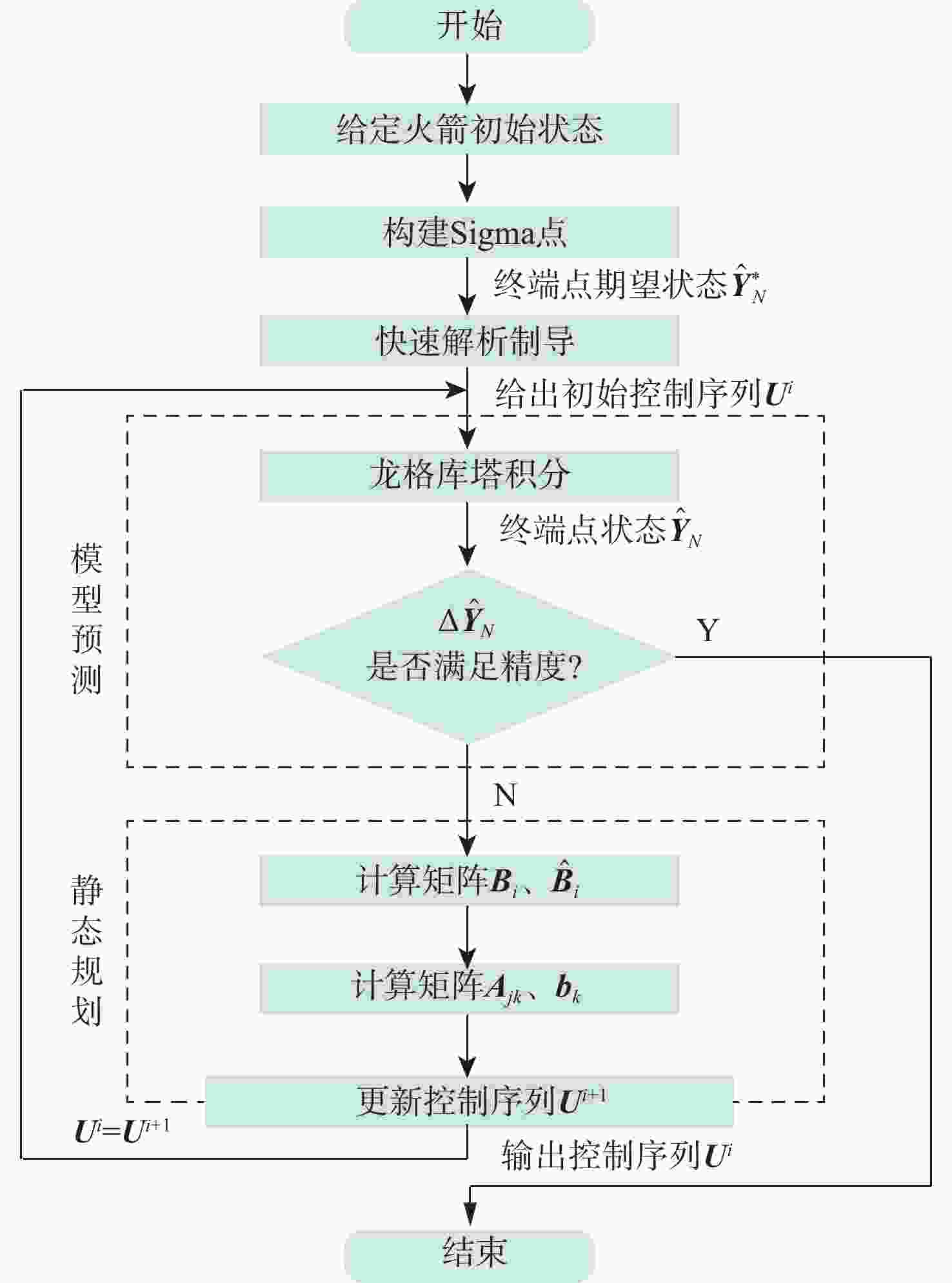
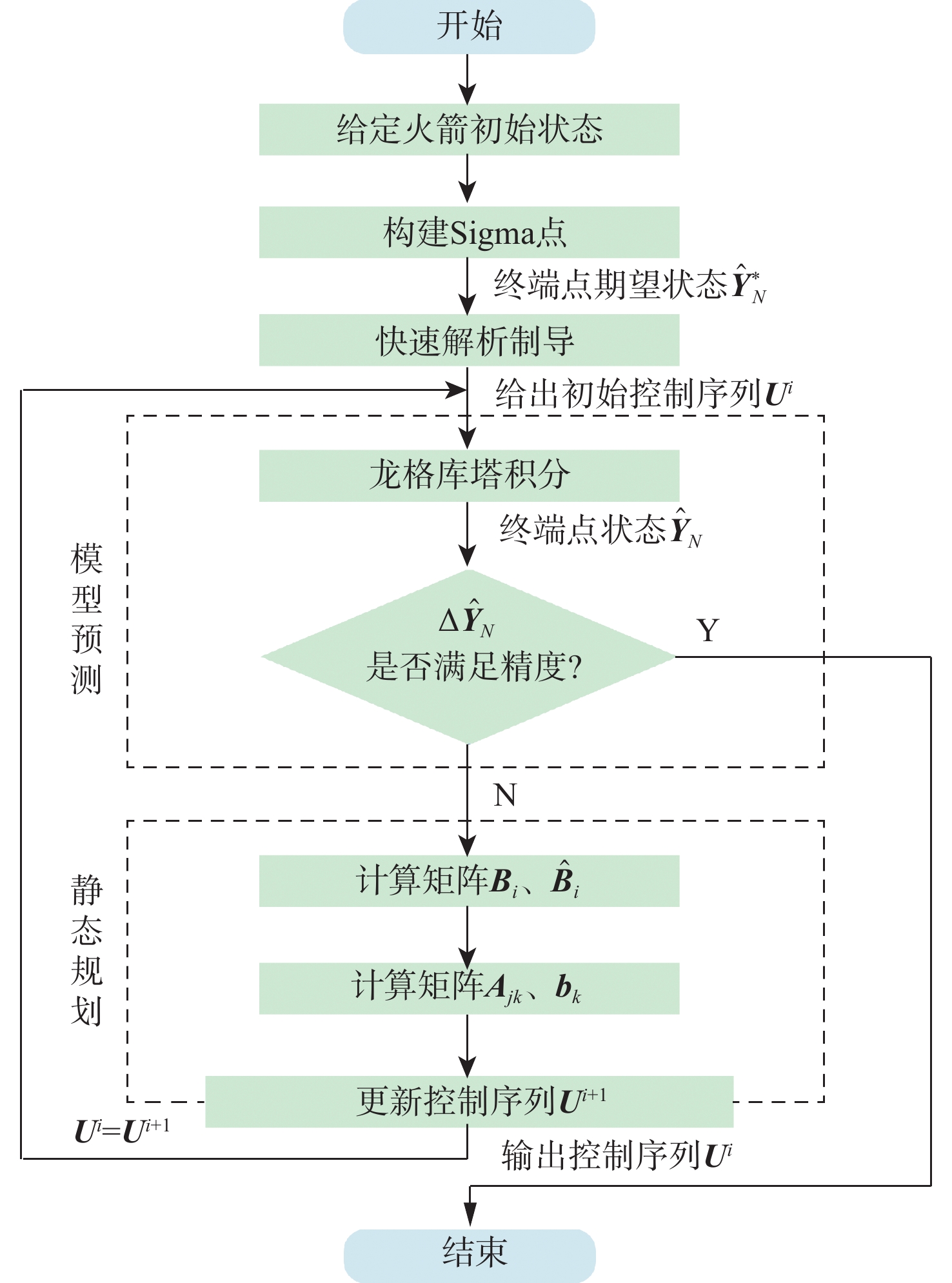
图 1 基于UMPSP的火箭着陆段鲁棒制导实现流程
Figure 1. Implementation process of robust guidance for rocket landing phase based on UMPSP
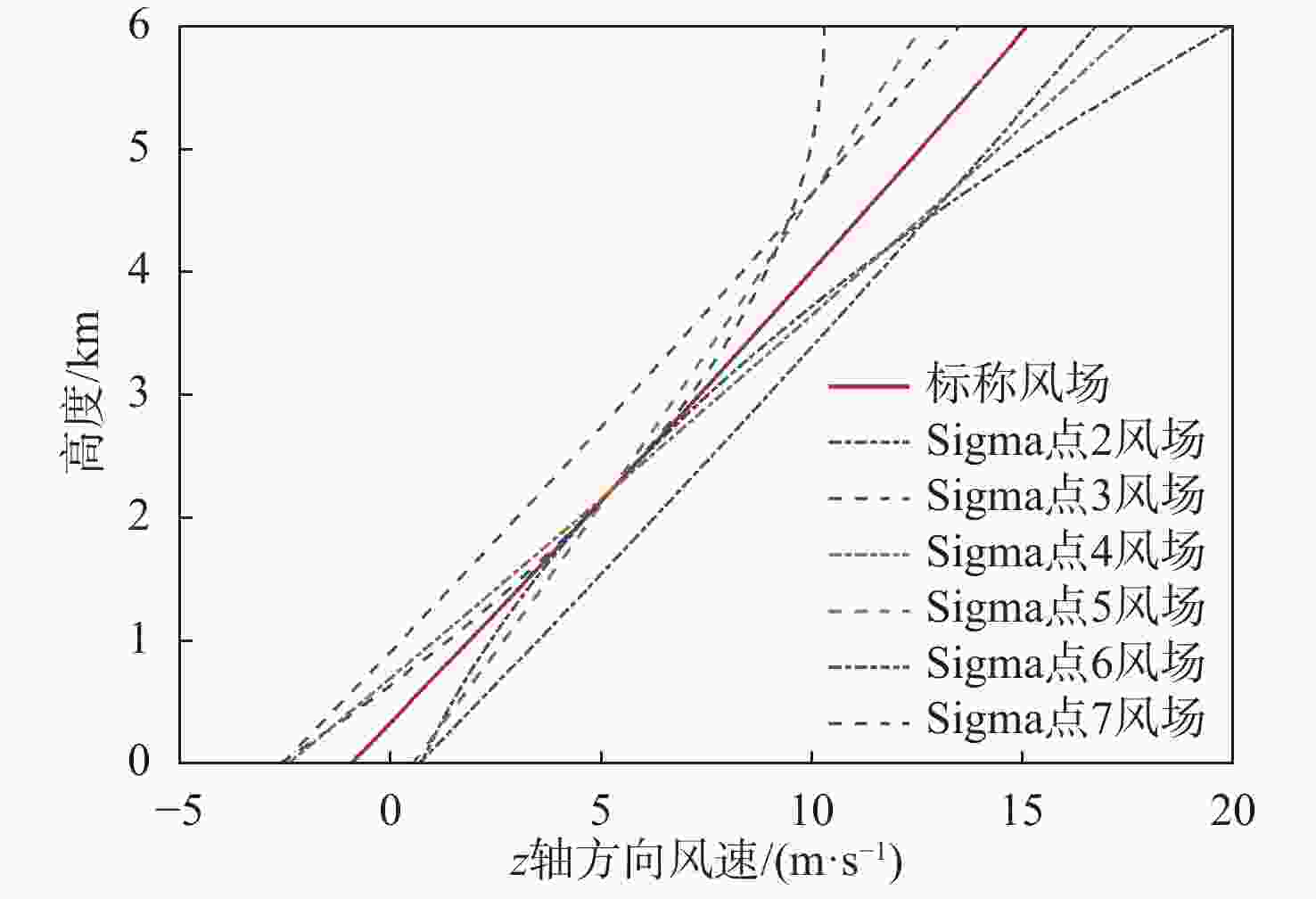
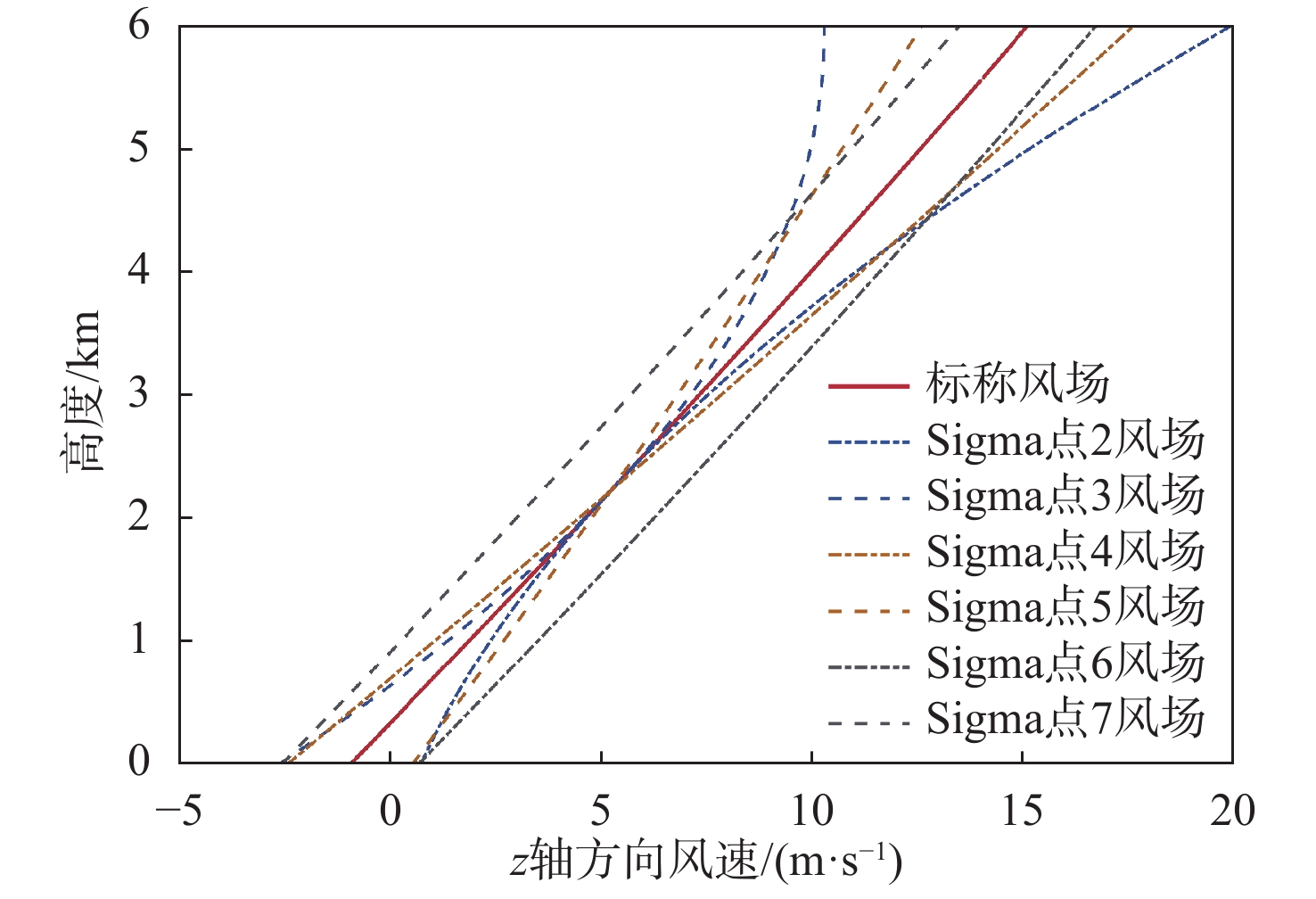
图 2 $ {\textit{z}} $方向标称风场与Sigma点风场
Figure 2. Nominal wind field and Sigma point wind field in the z direction
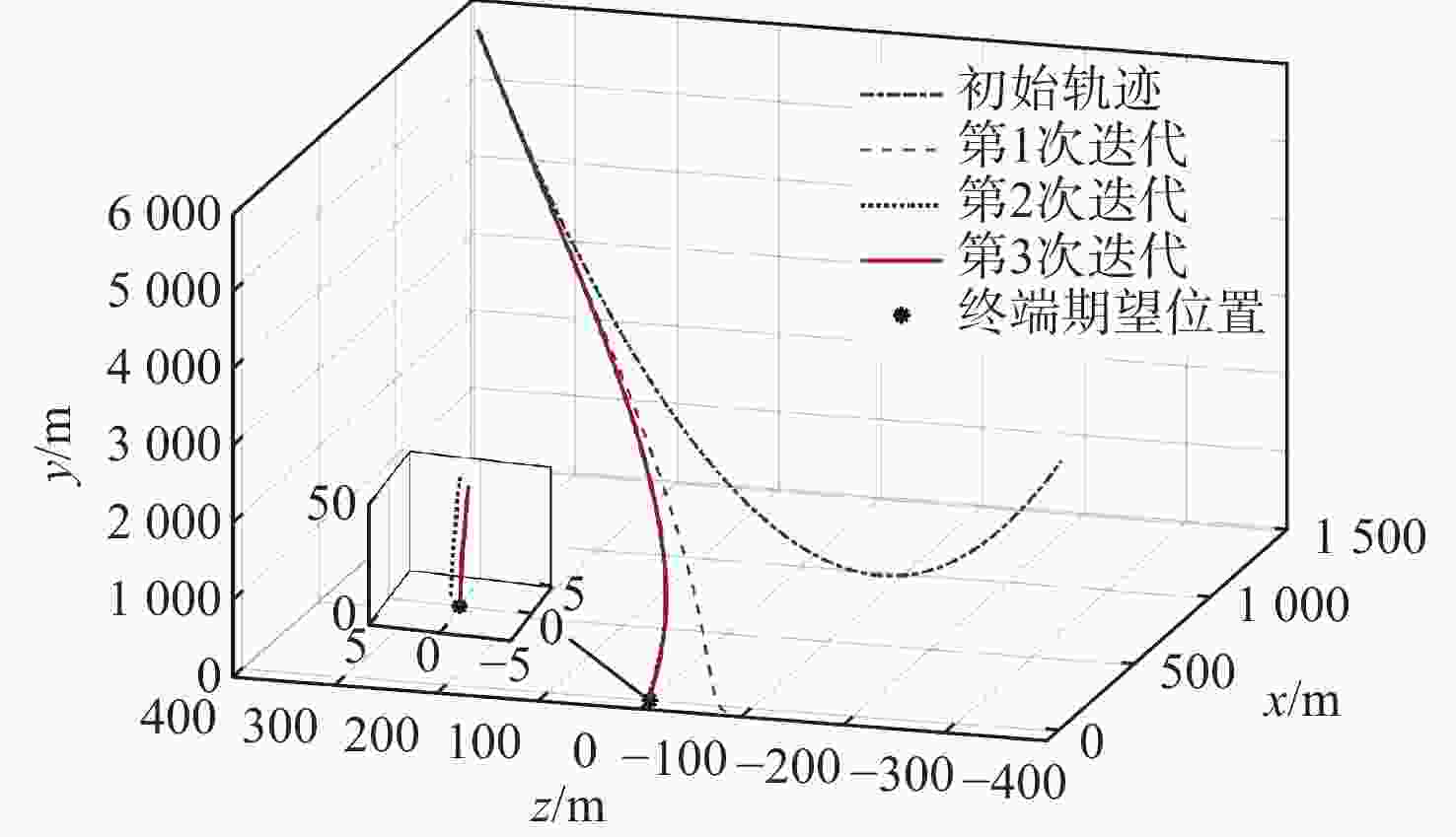
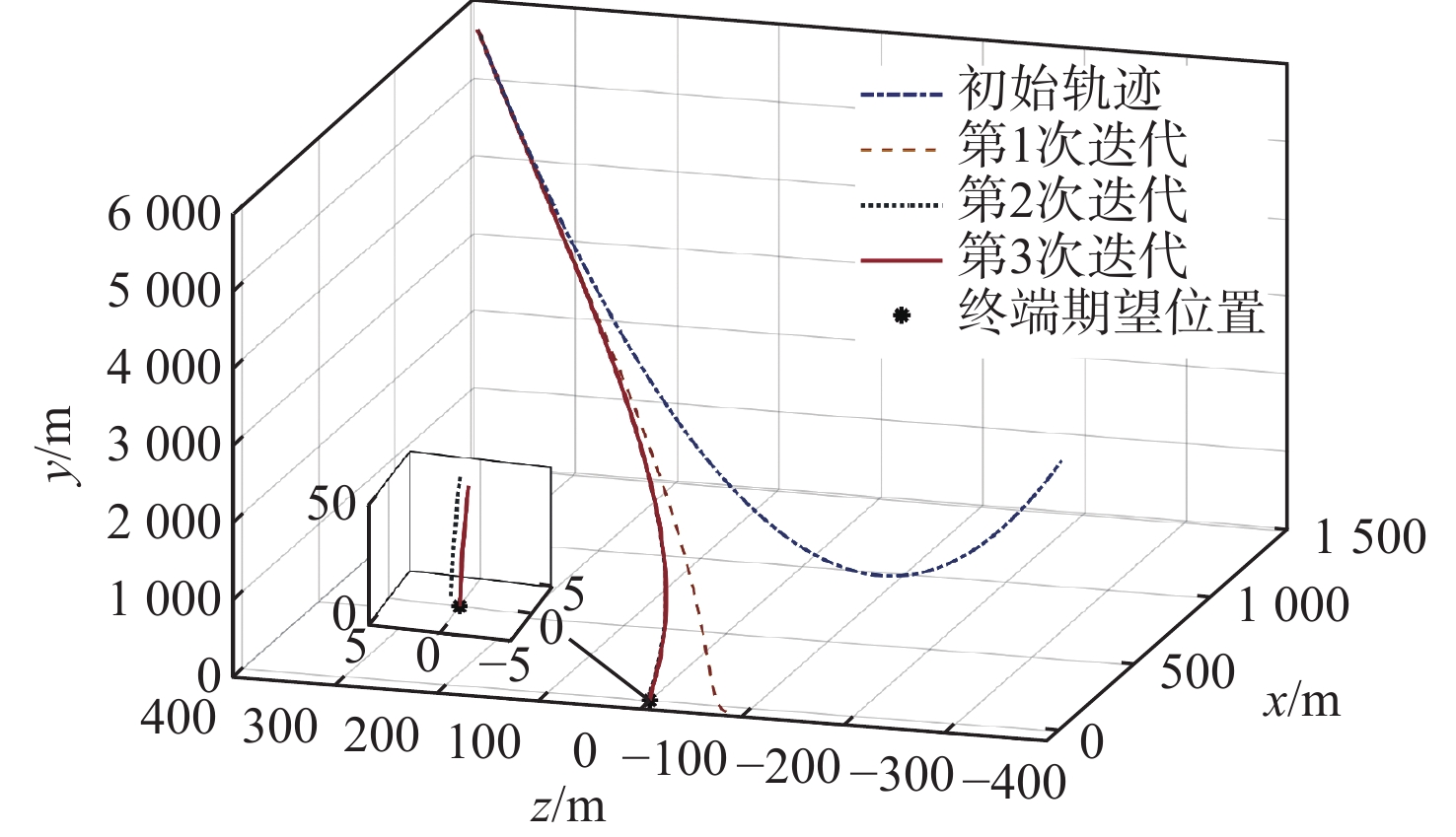
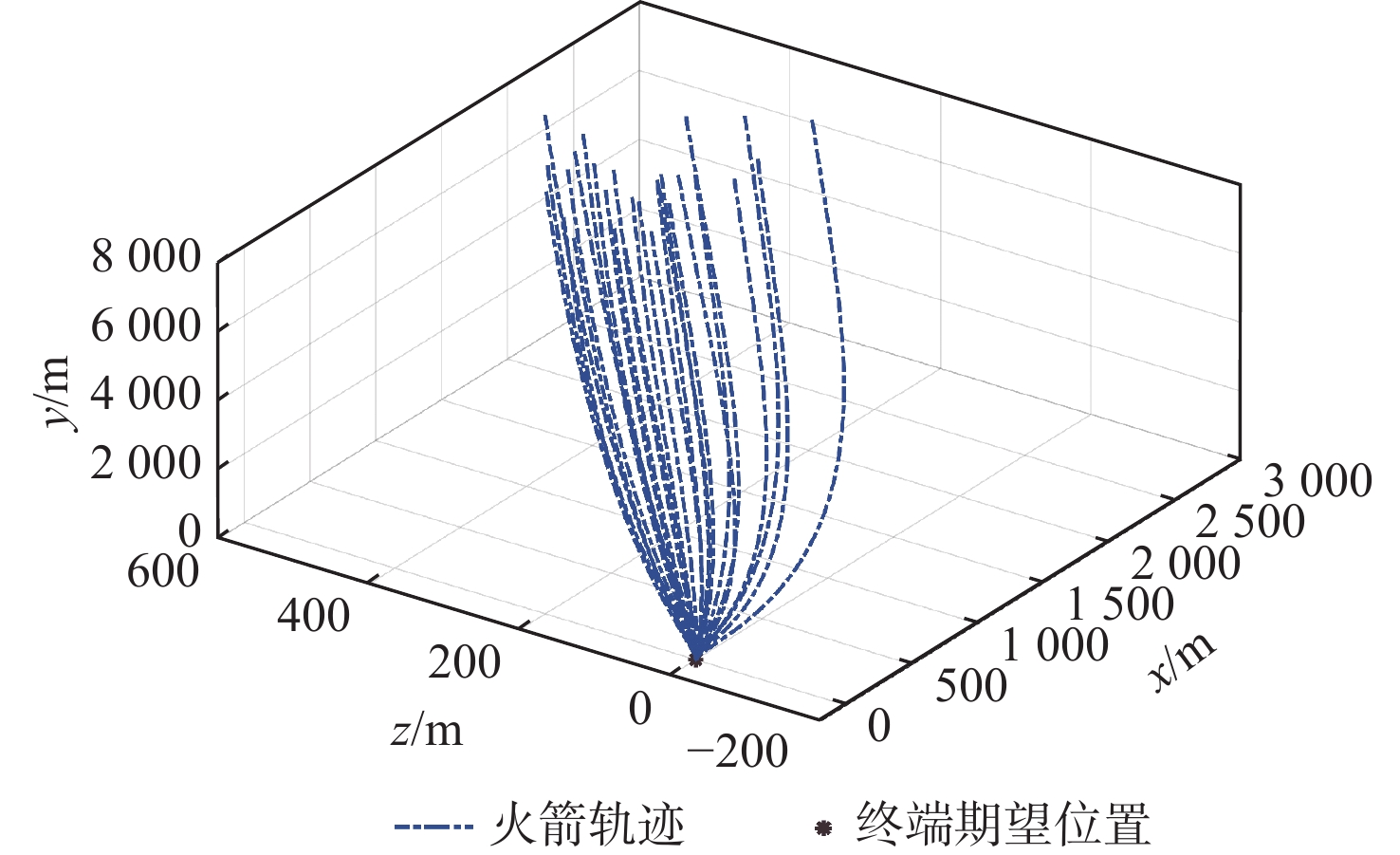
图 3 基于UMPSP制导方法的火箭着陆段迭代轨迹
Figure 3. Iterative trajectory of rocket landing phase based on UMPSP guidance method
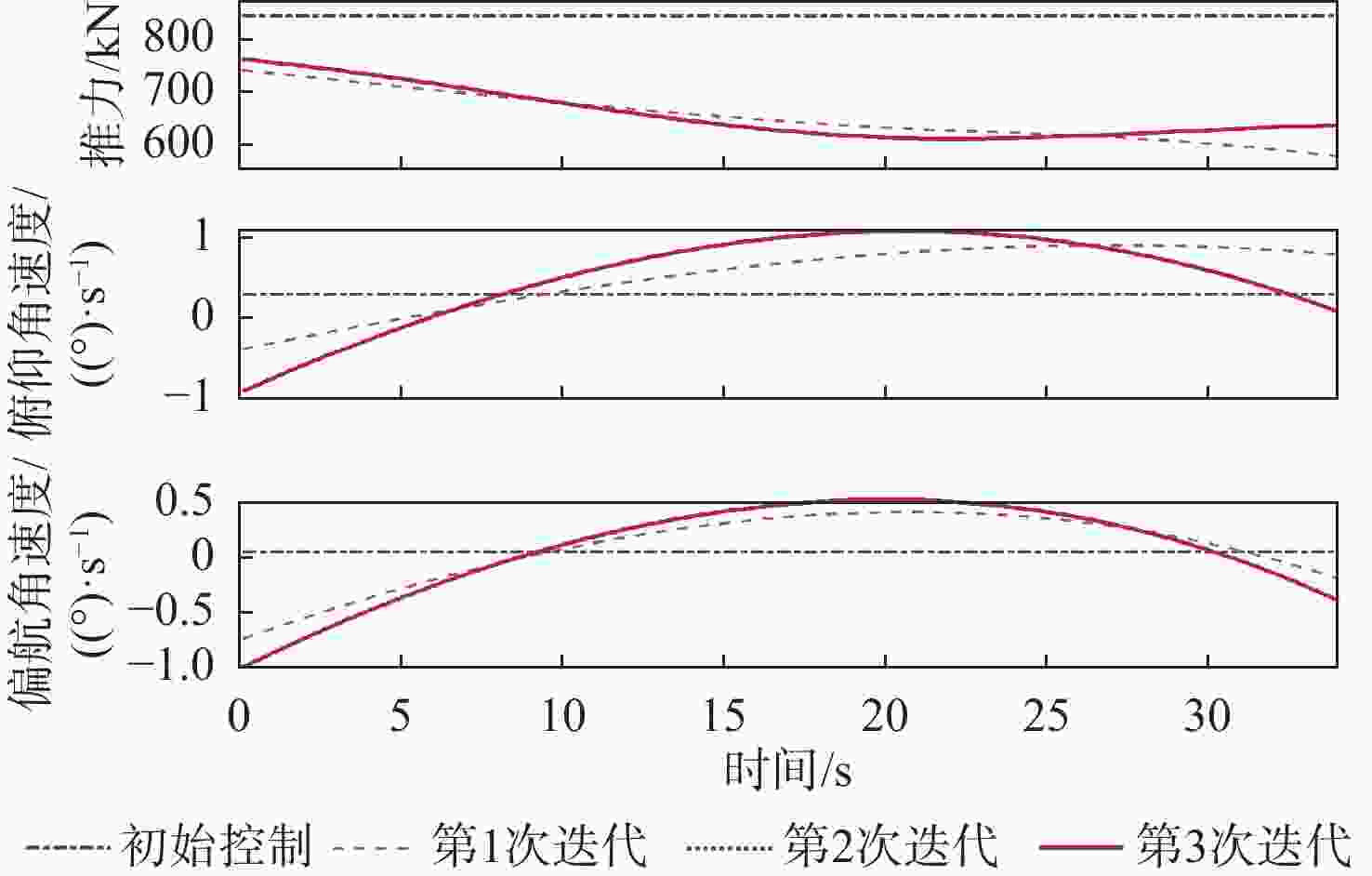
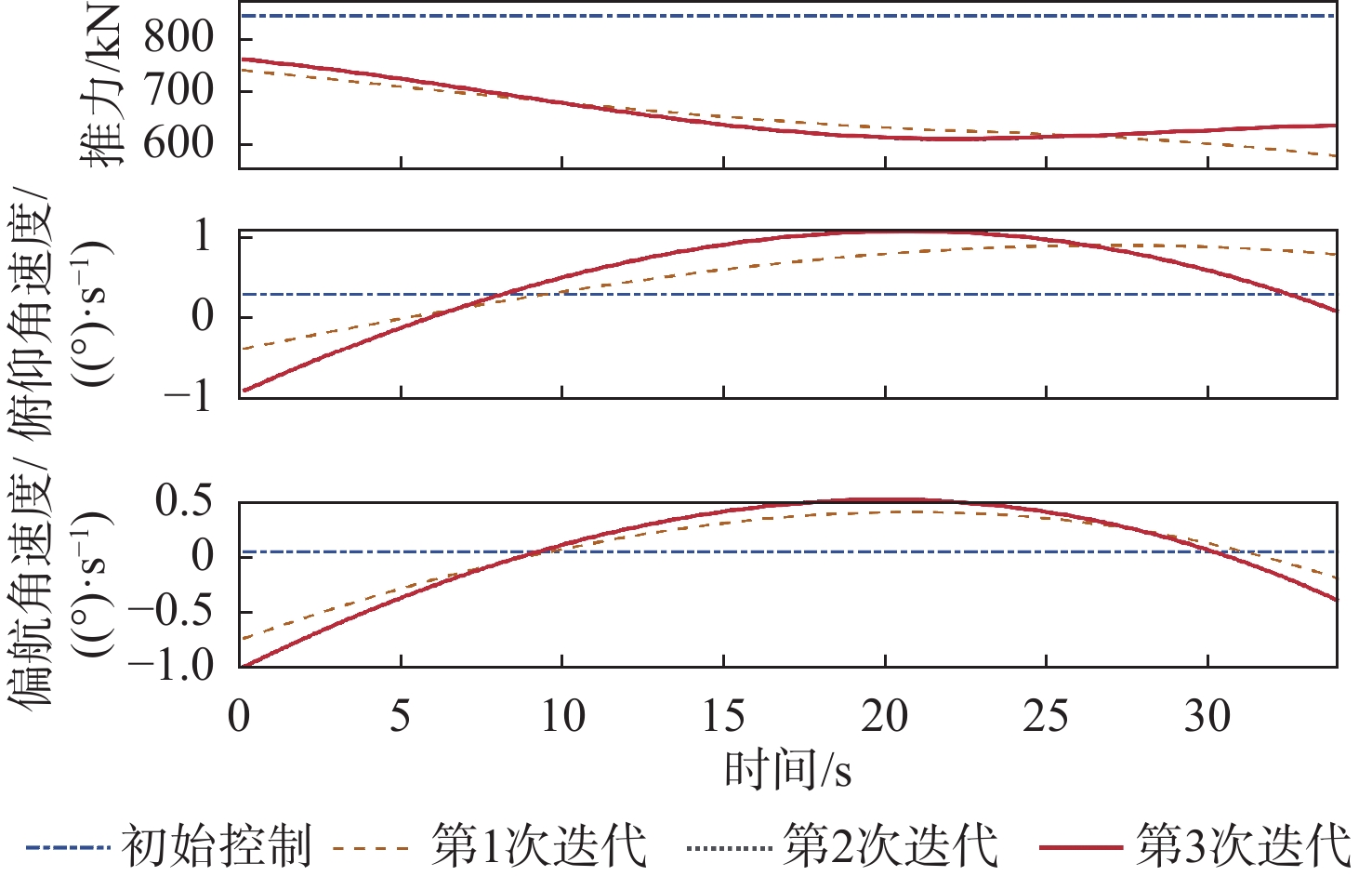
图 4 算例1基于UMPSP制导方法的火箭着陆段控制-时间曲线
Figure 4. Control-time curves of rocket landing phase based on UMPSP guidance method in example 1
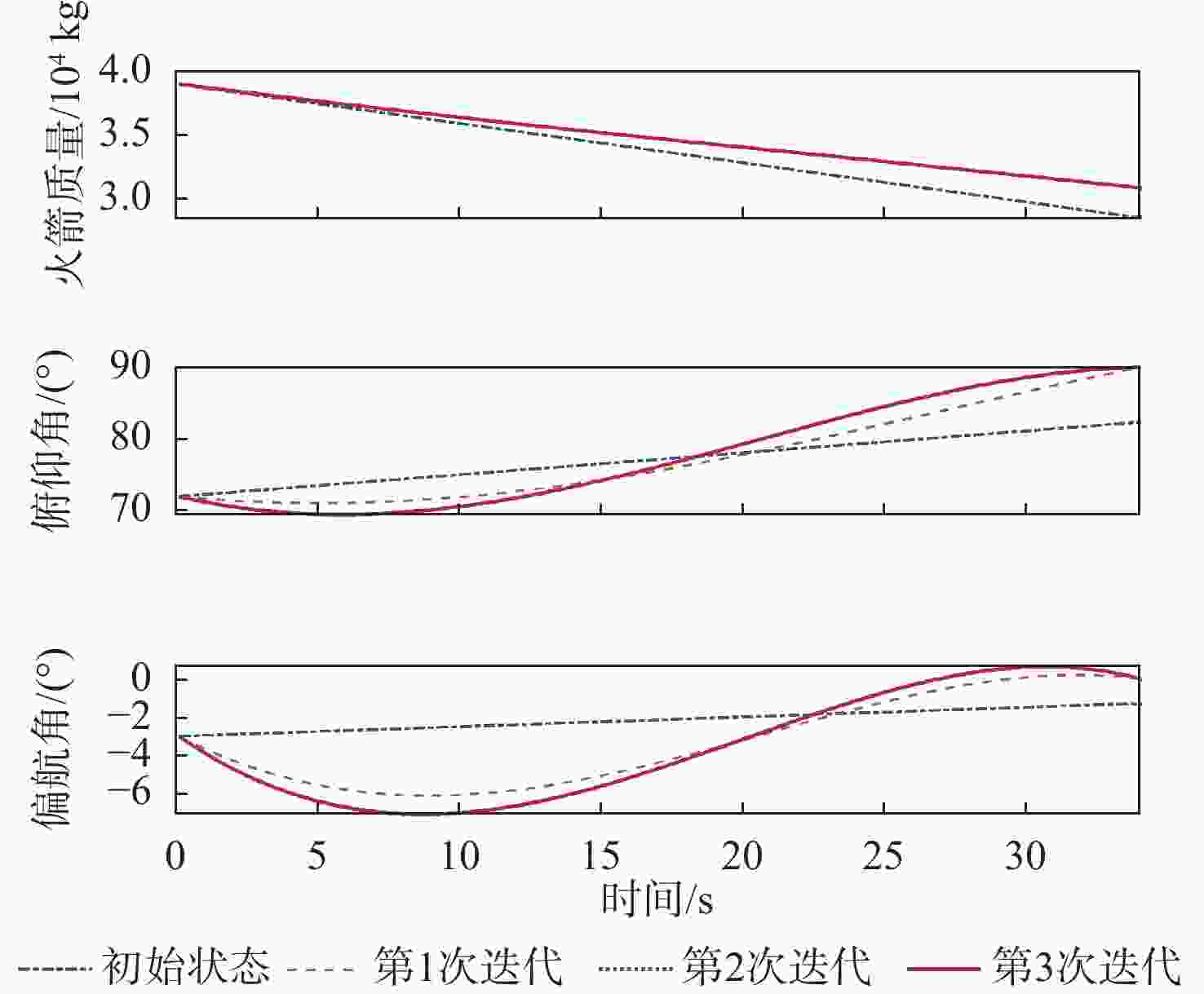
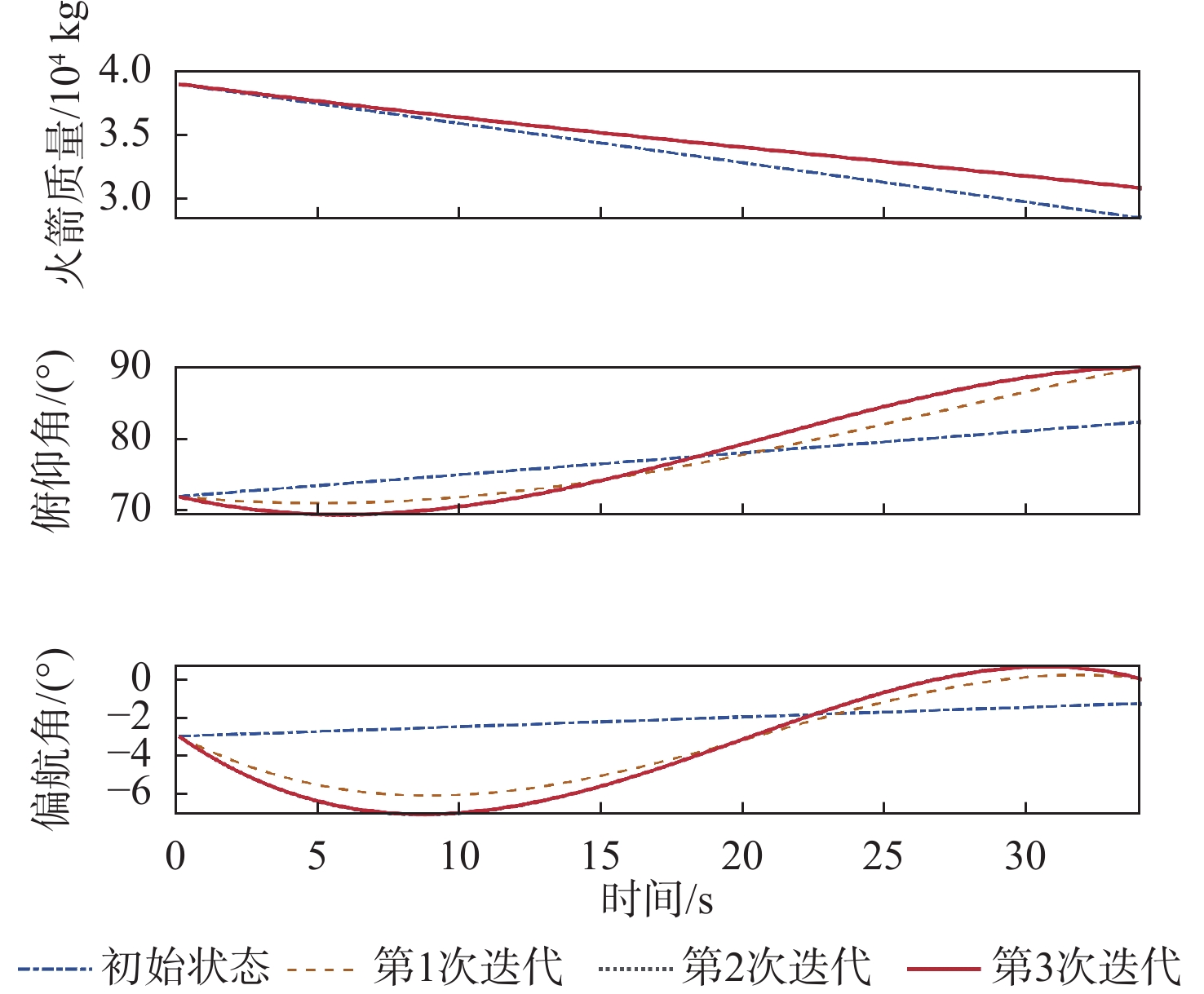
图 5 算例1基于UMPSP制导方法的火箭着陆段状态-时间曲线
Figure 5. State-time curves of rocket landing phase based on UMPSP guidance method in example 1
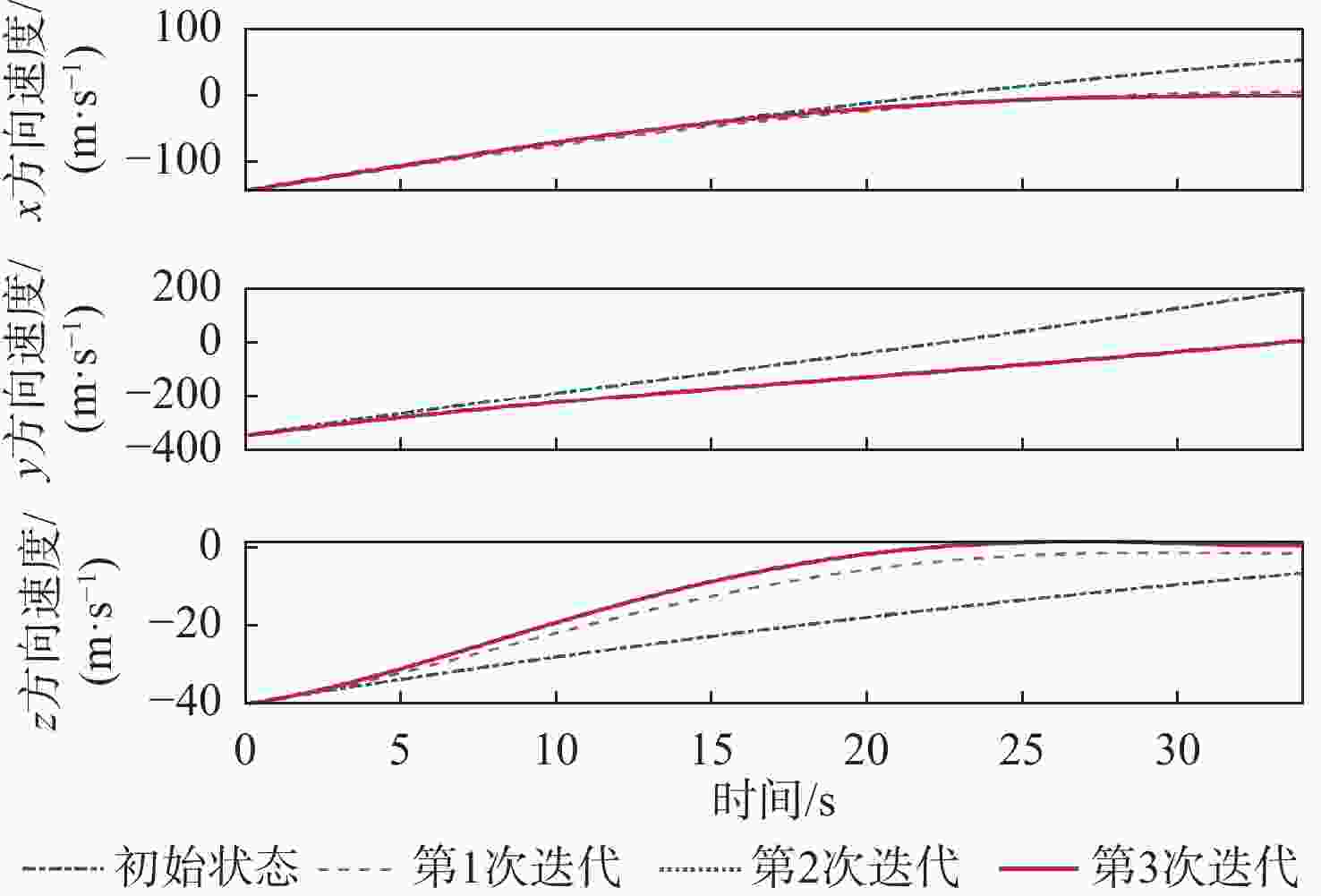
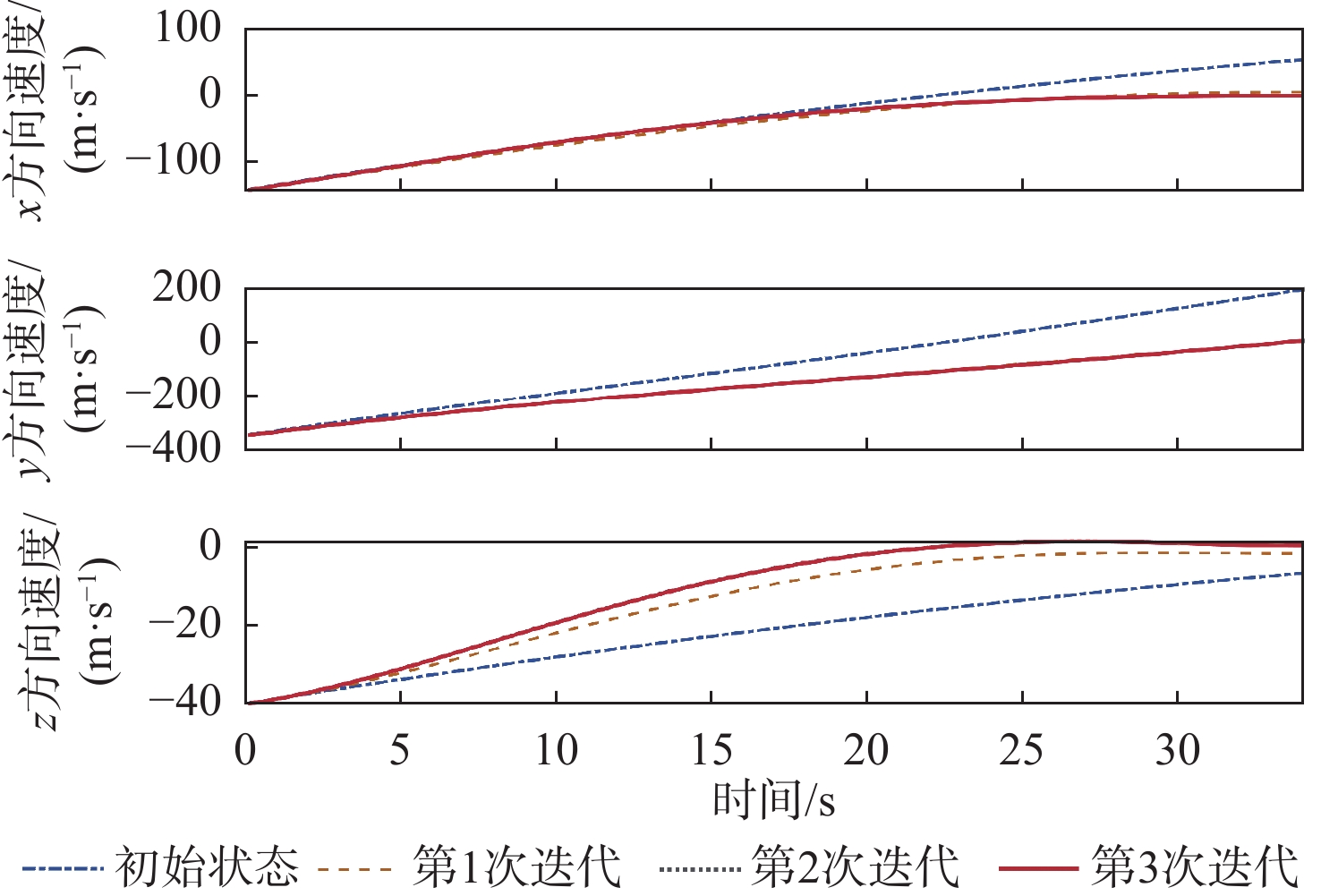
图 6 算例1基于UMPSP制导方法的火箭着陆段速度-时间曲线
Figure 6. Velocity-time curves of rocket landing phase based on UMPSP guidance method in example 1
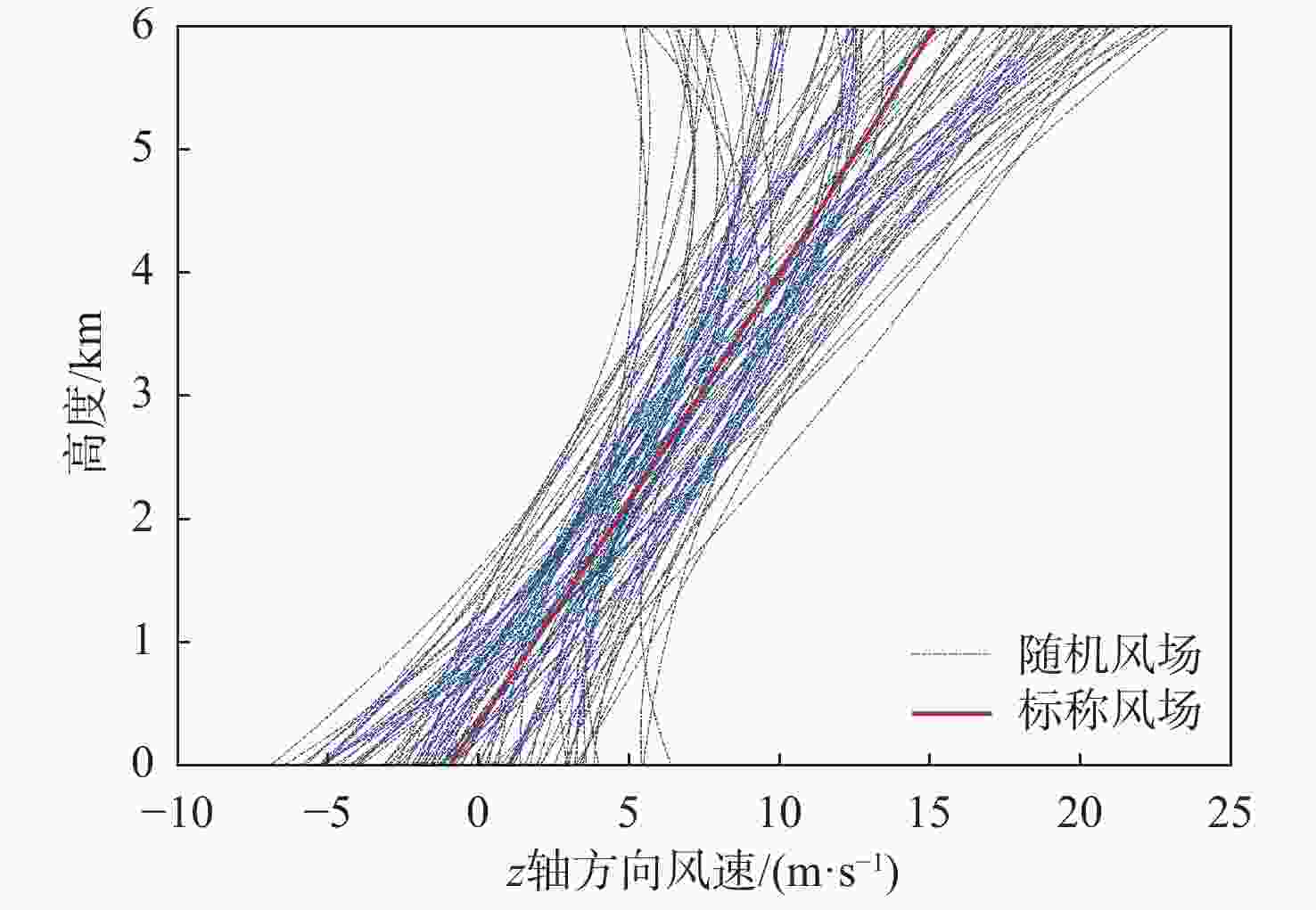
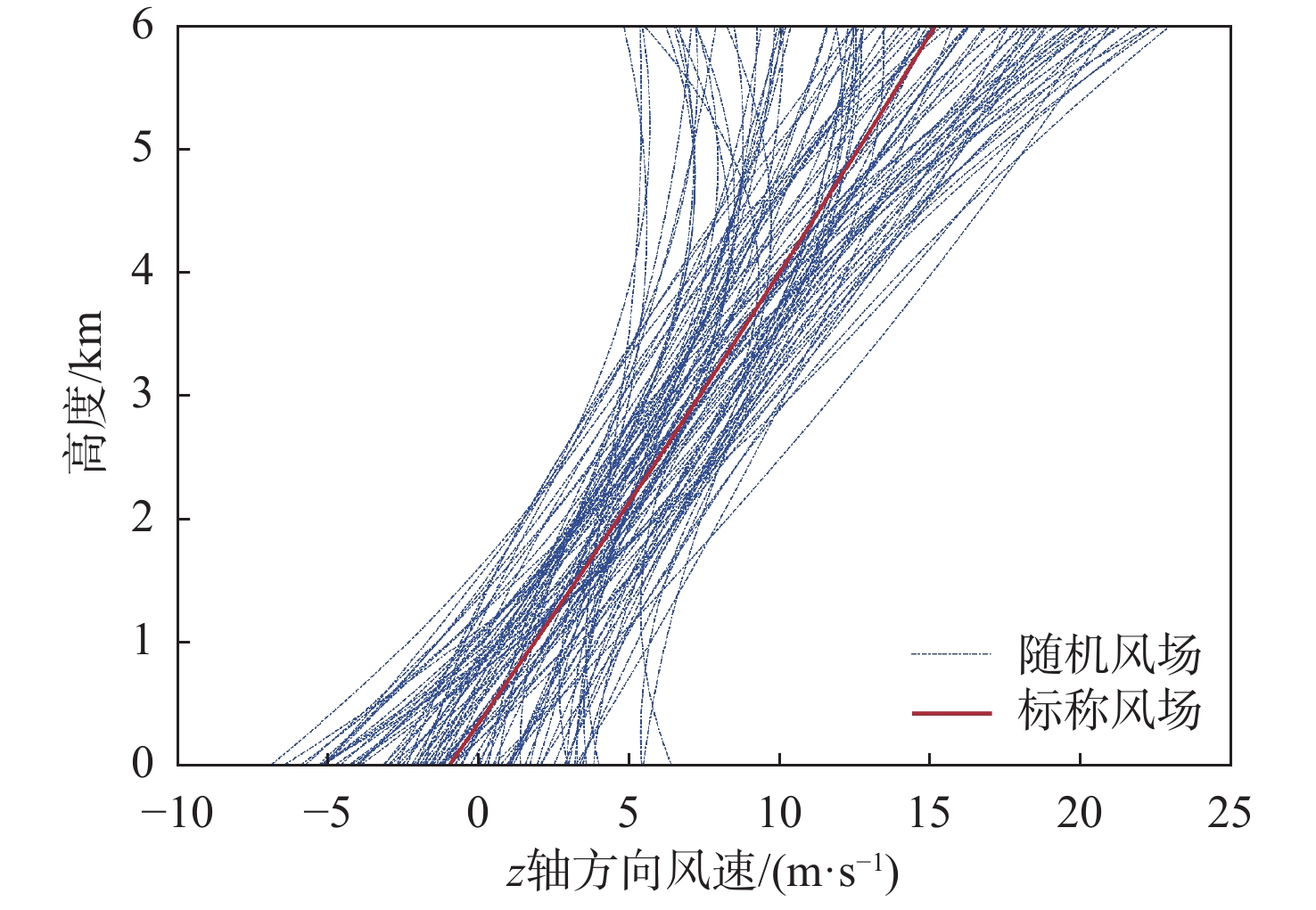
图 7 $ {\textit{z}} $方向标称风场与100组随机风场
Figure 7. Nominal wind field and 100 sets of random wind fields in the z direction
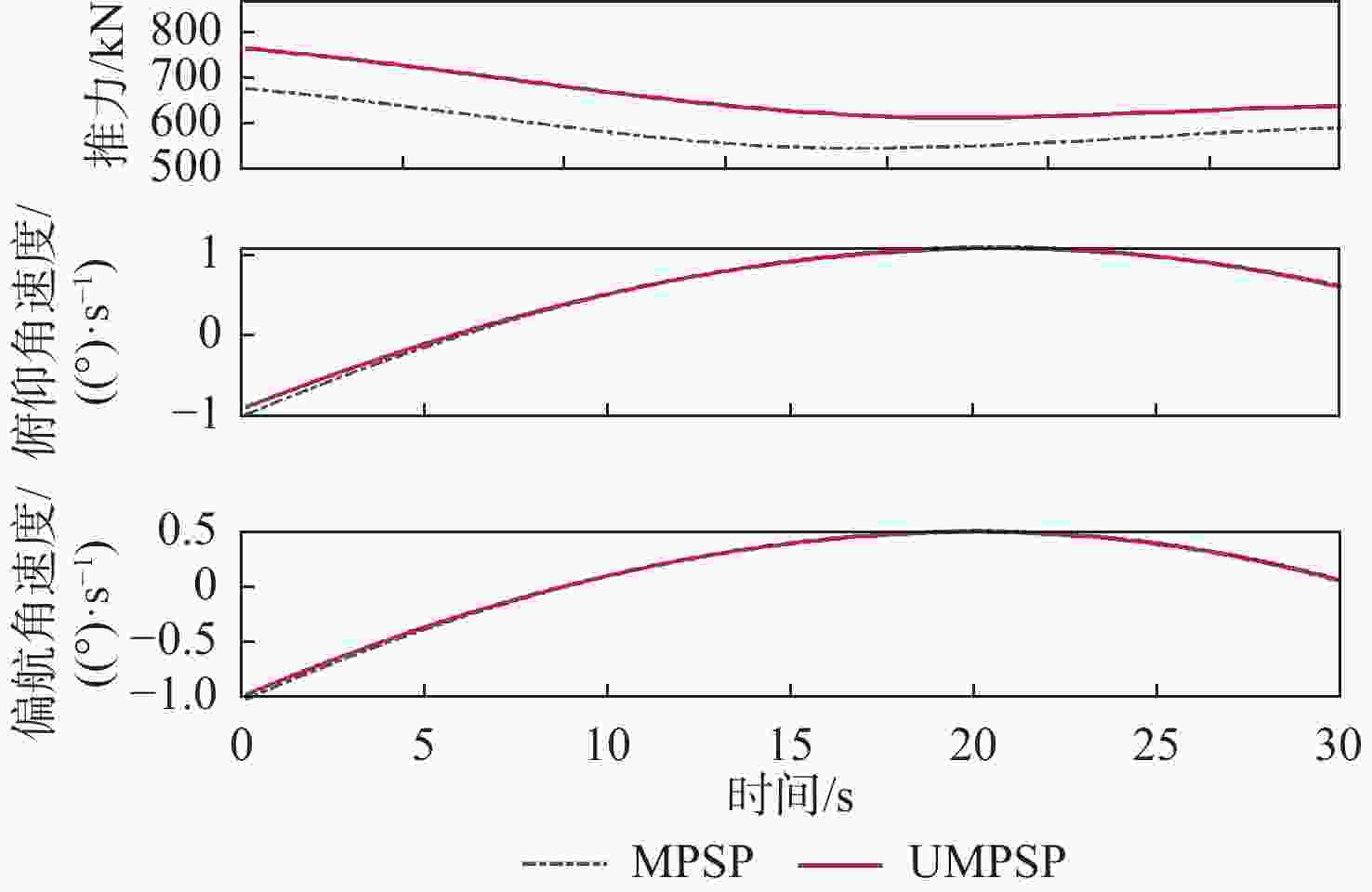
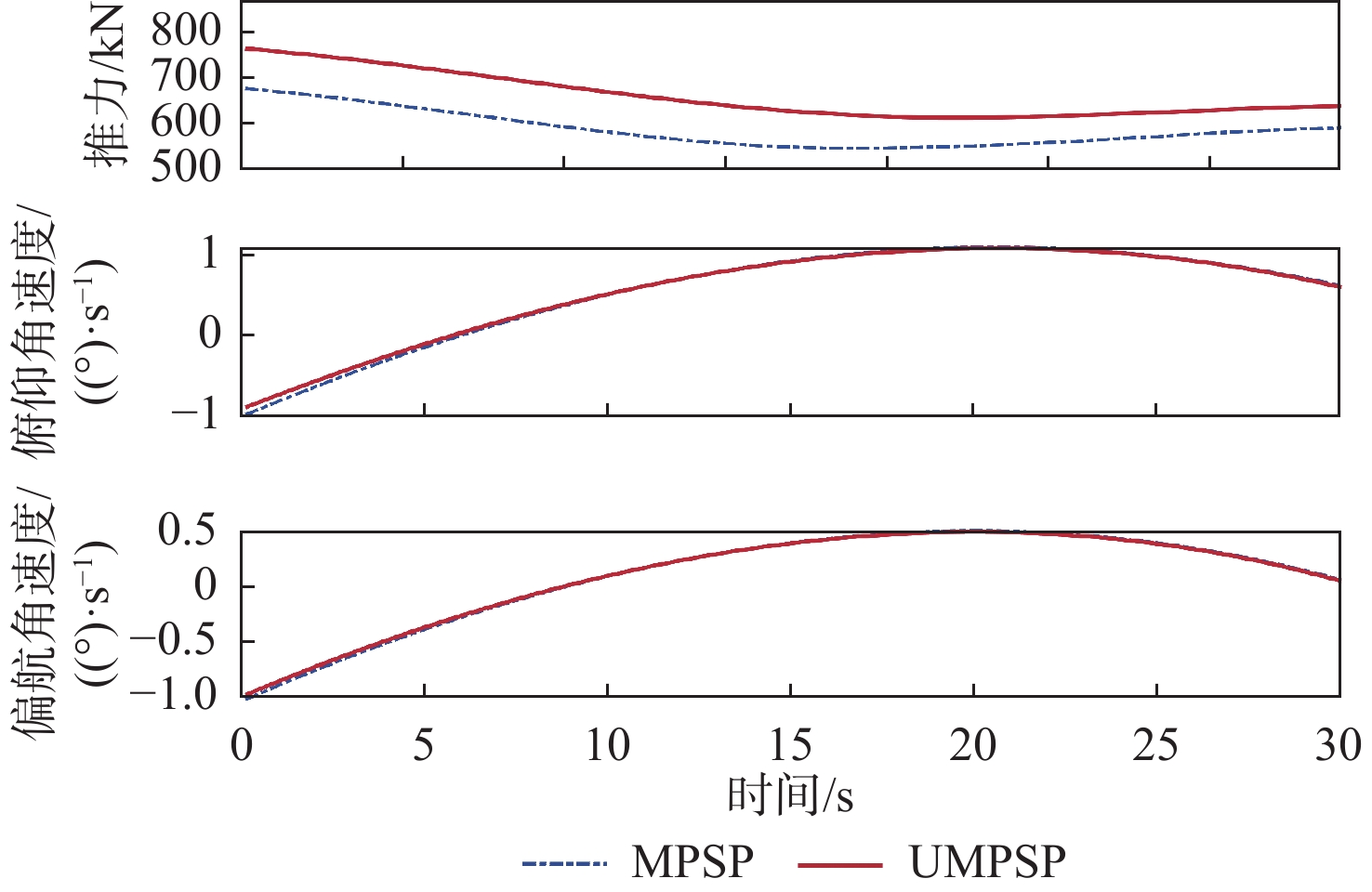
图 8 UMPSP制导方法与MPSP制导方法的控制-时间对比曲线
Figure 8. Control-time comparison curves between UMPSP guidance method and MPSP guidance method
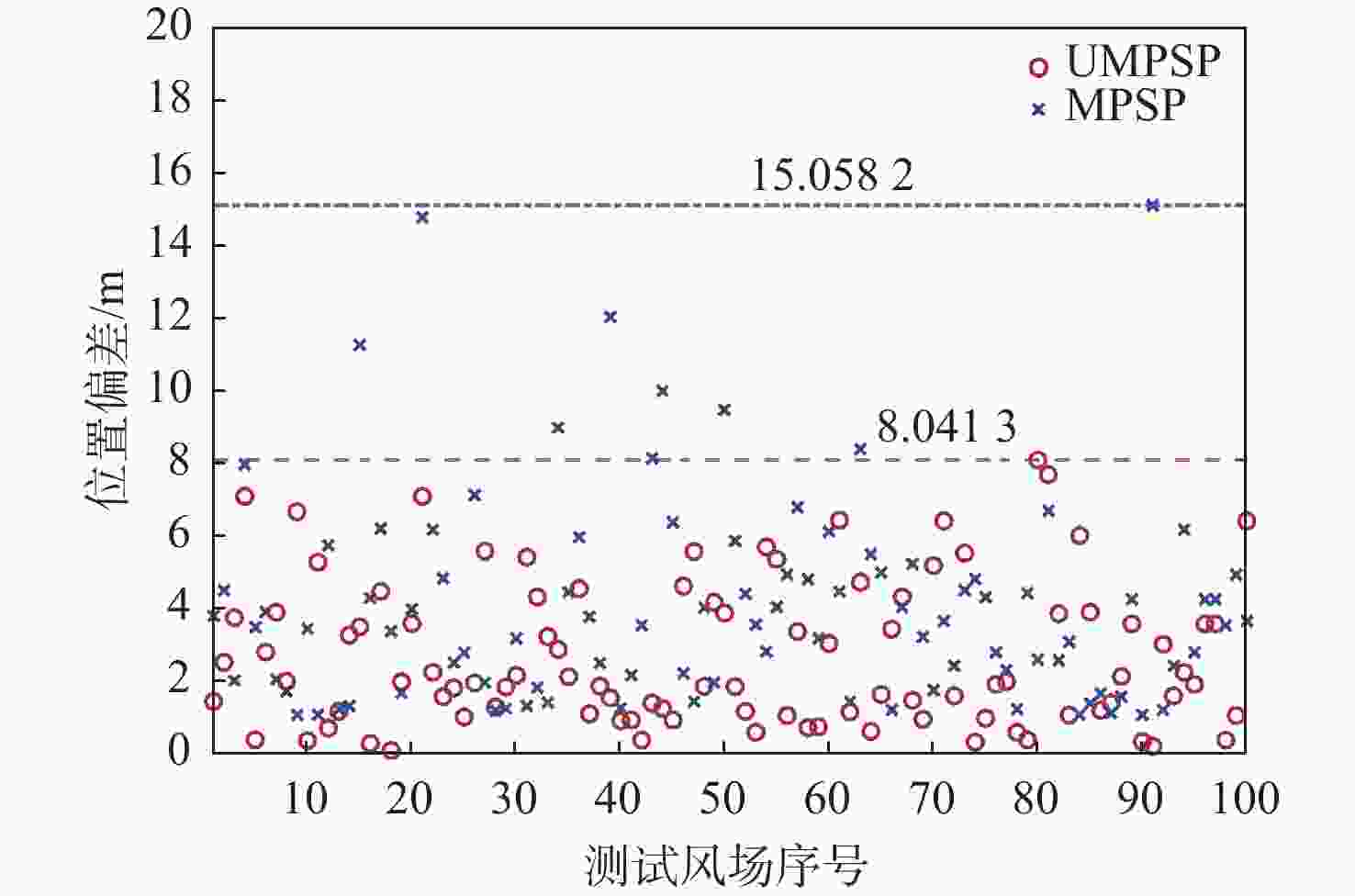
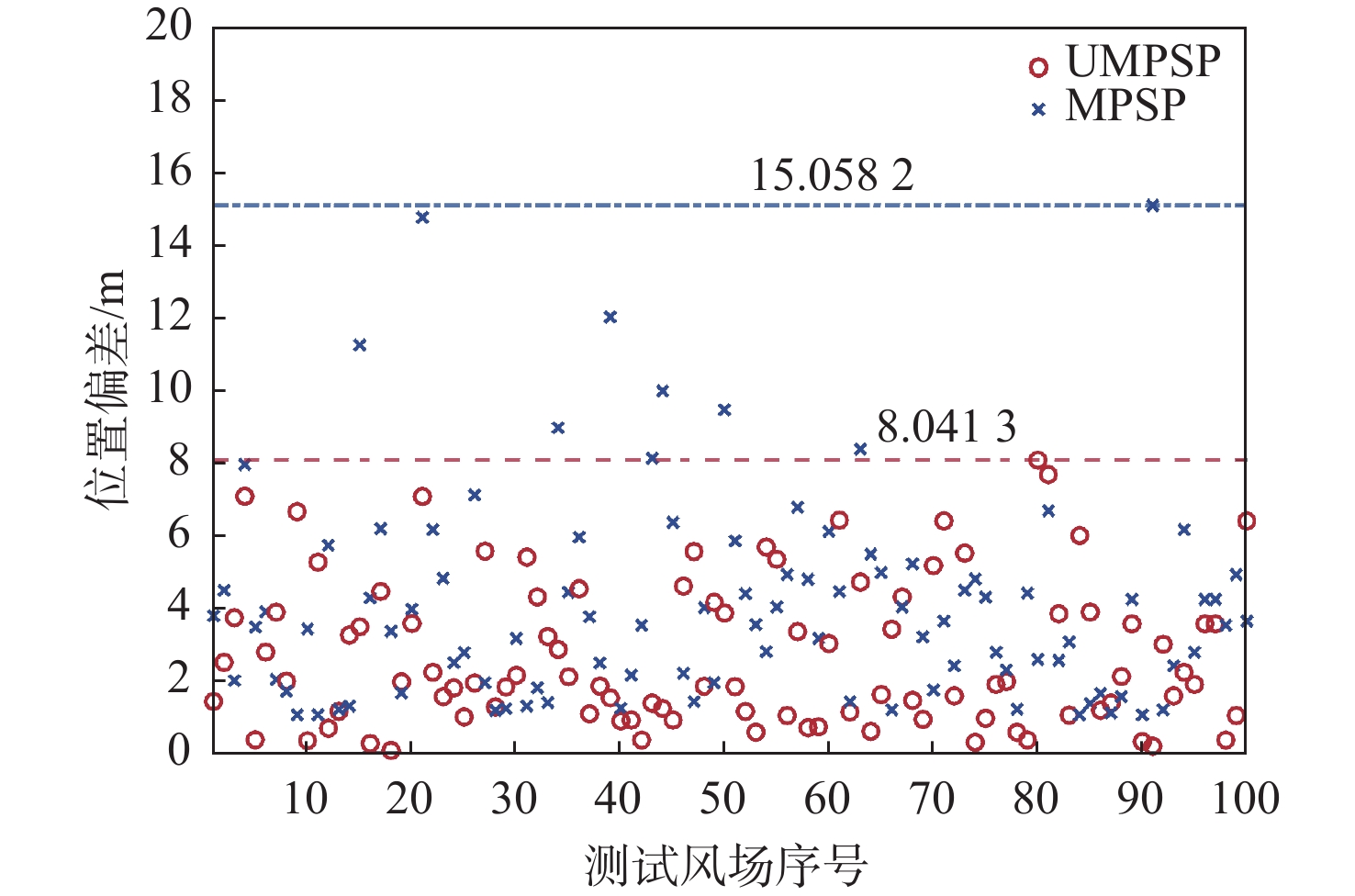
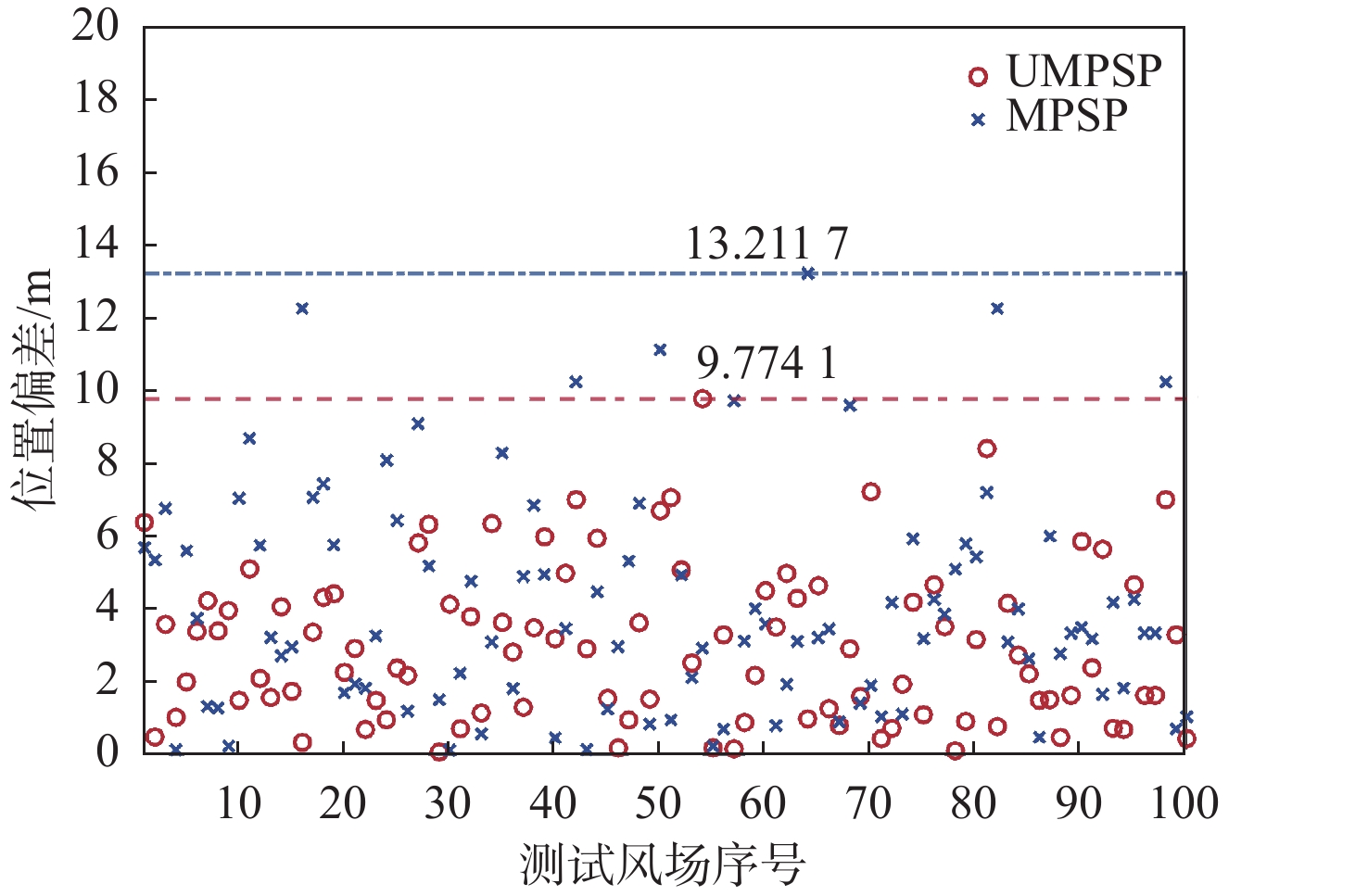
图 9 随机风场下终端位置偏差对比
Figure 9. Comparison of terminal position deviations under random wind fields
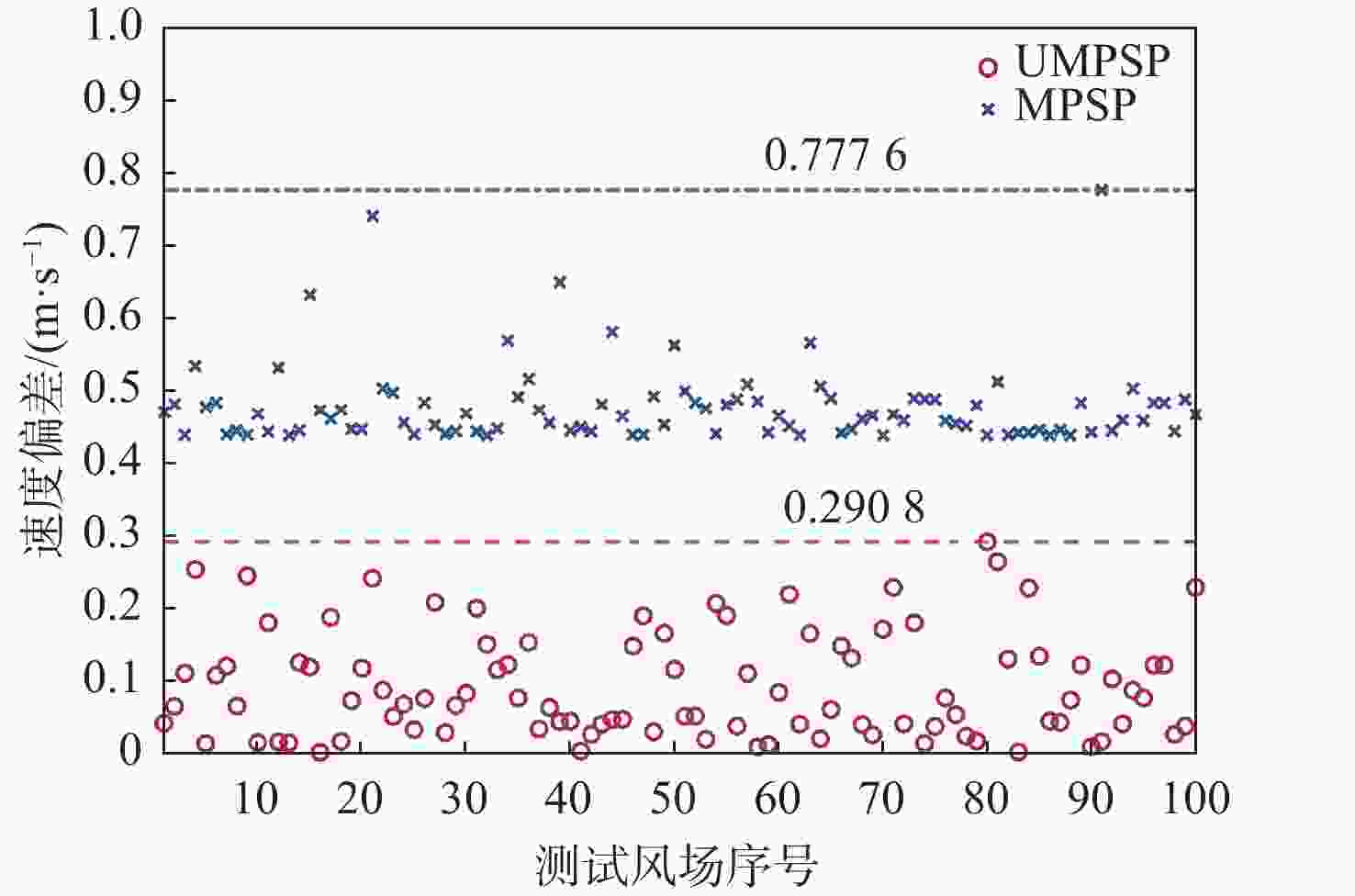
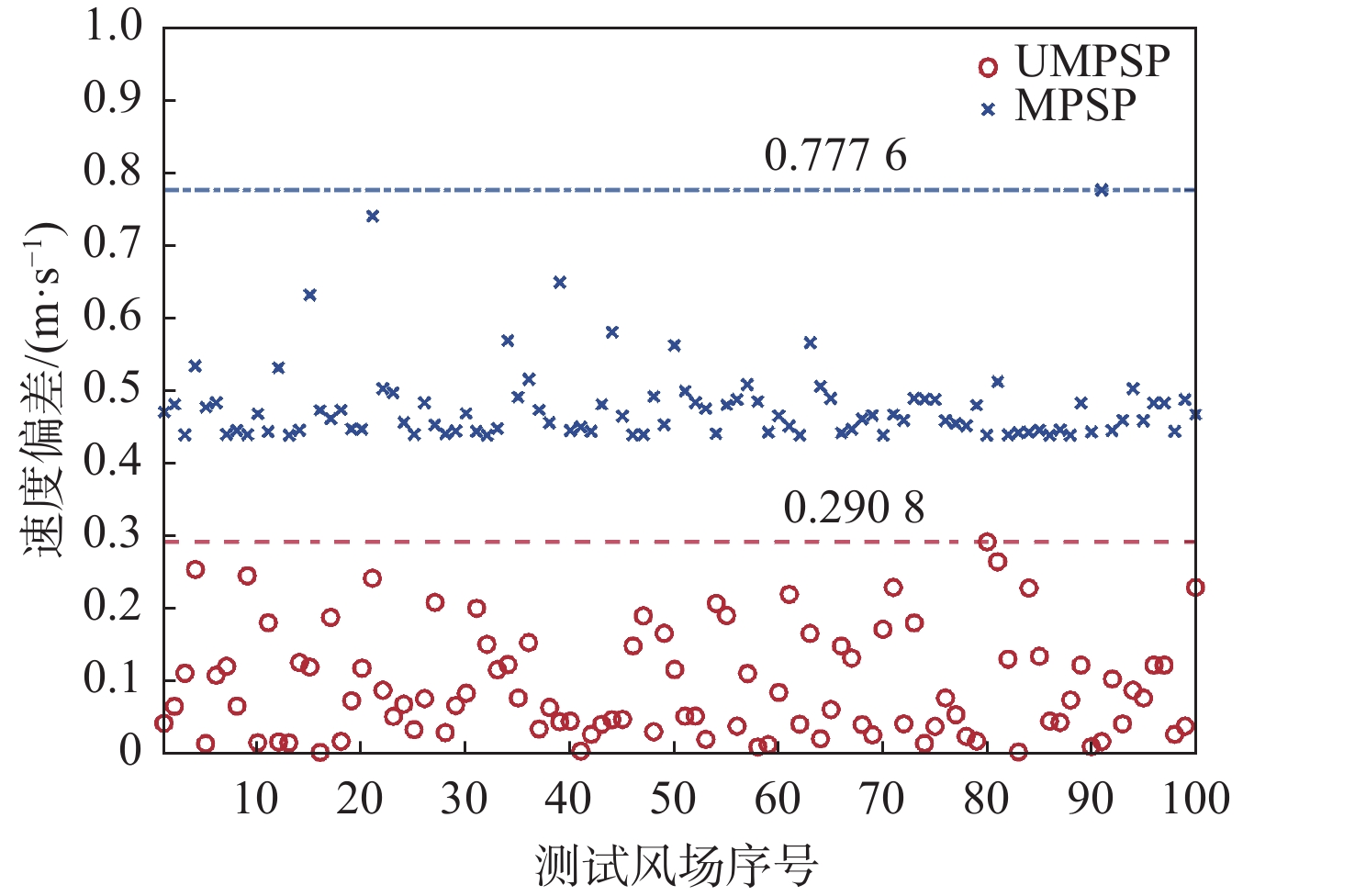
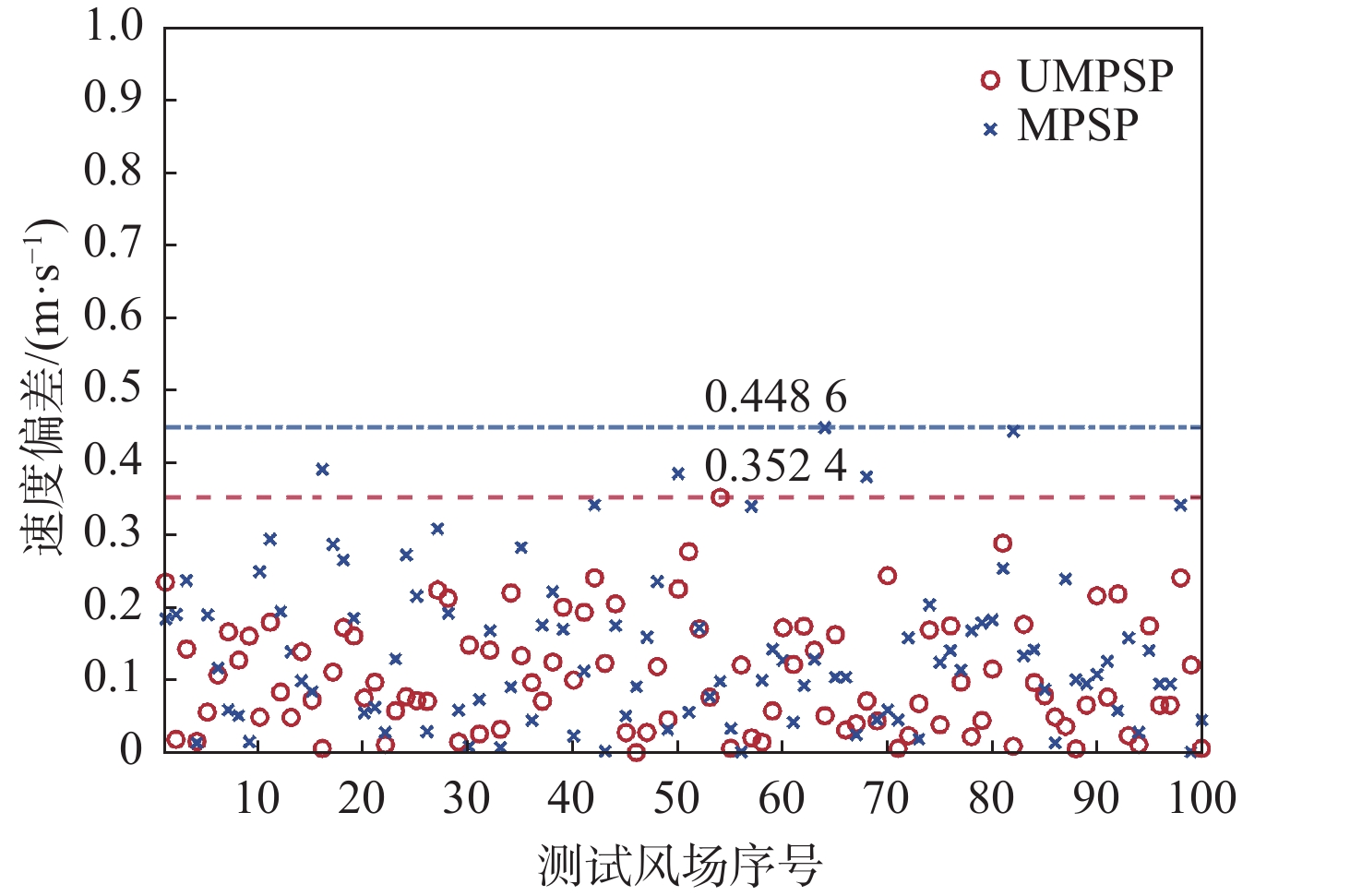
图 10 随机风场下终端速度偏差对比
Figure 10. Comparison of terminal velocity deviations under random wind fields
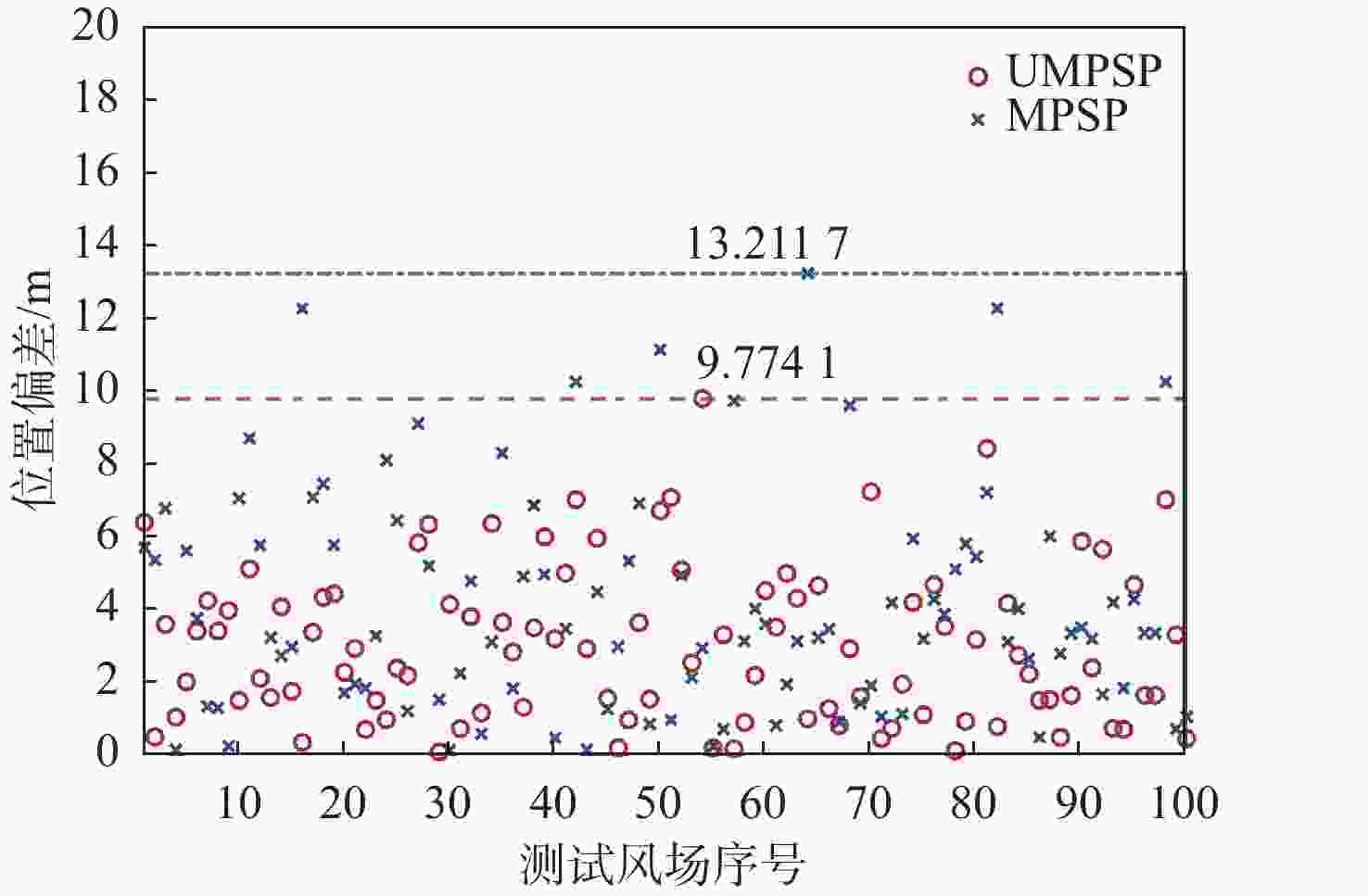
图 11 随机风场存在统计偏差下终端位置偏差对比
Figure 11. Comparison of terminal position deviations under statistical bias in random wind fields
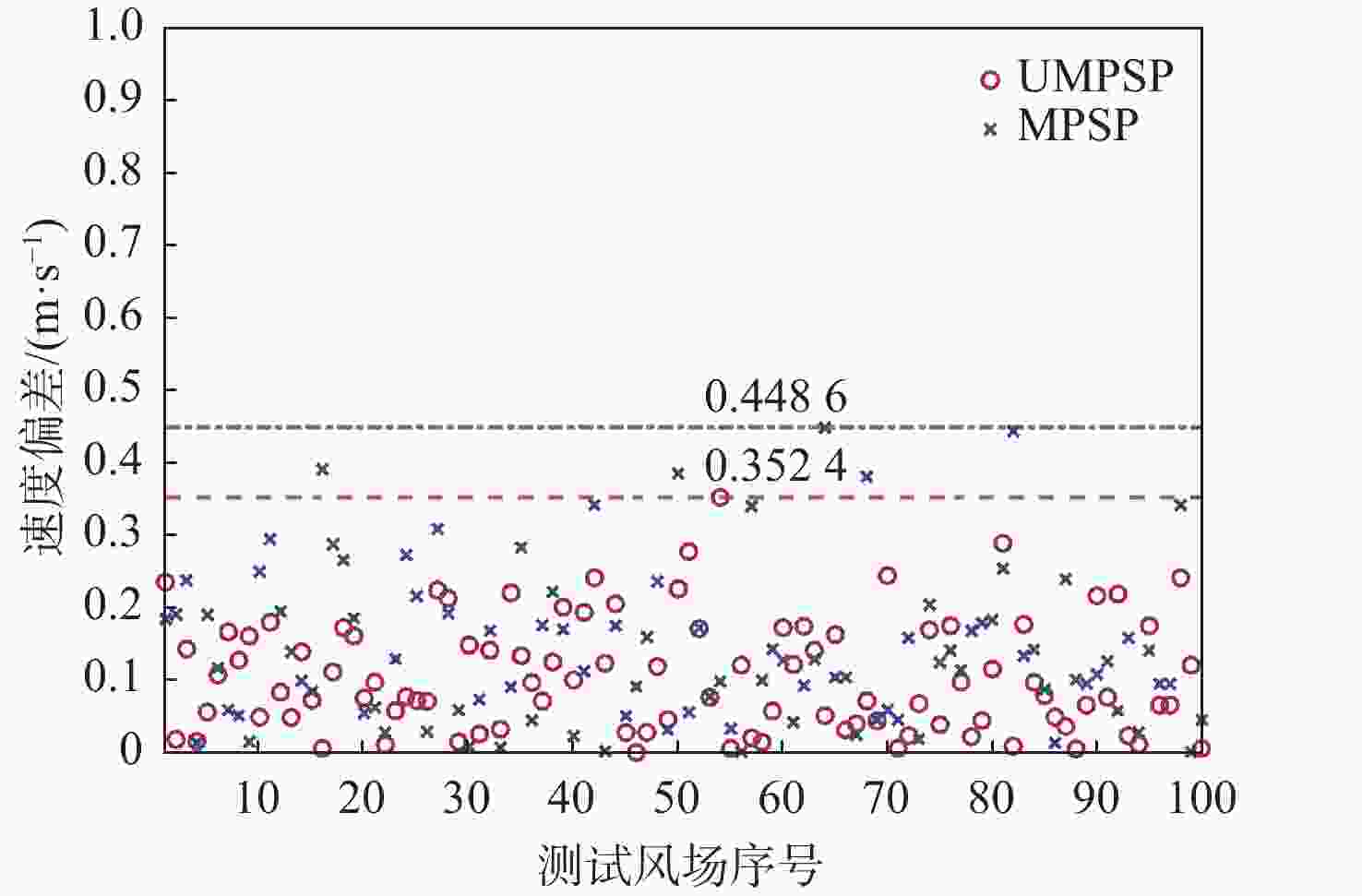
图 12 随机风场存在统计偏差下终端速度偏差对比
Figure 12. Comparison of terminal velocity deviations under statistical bias in random wind fields
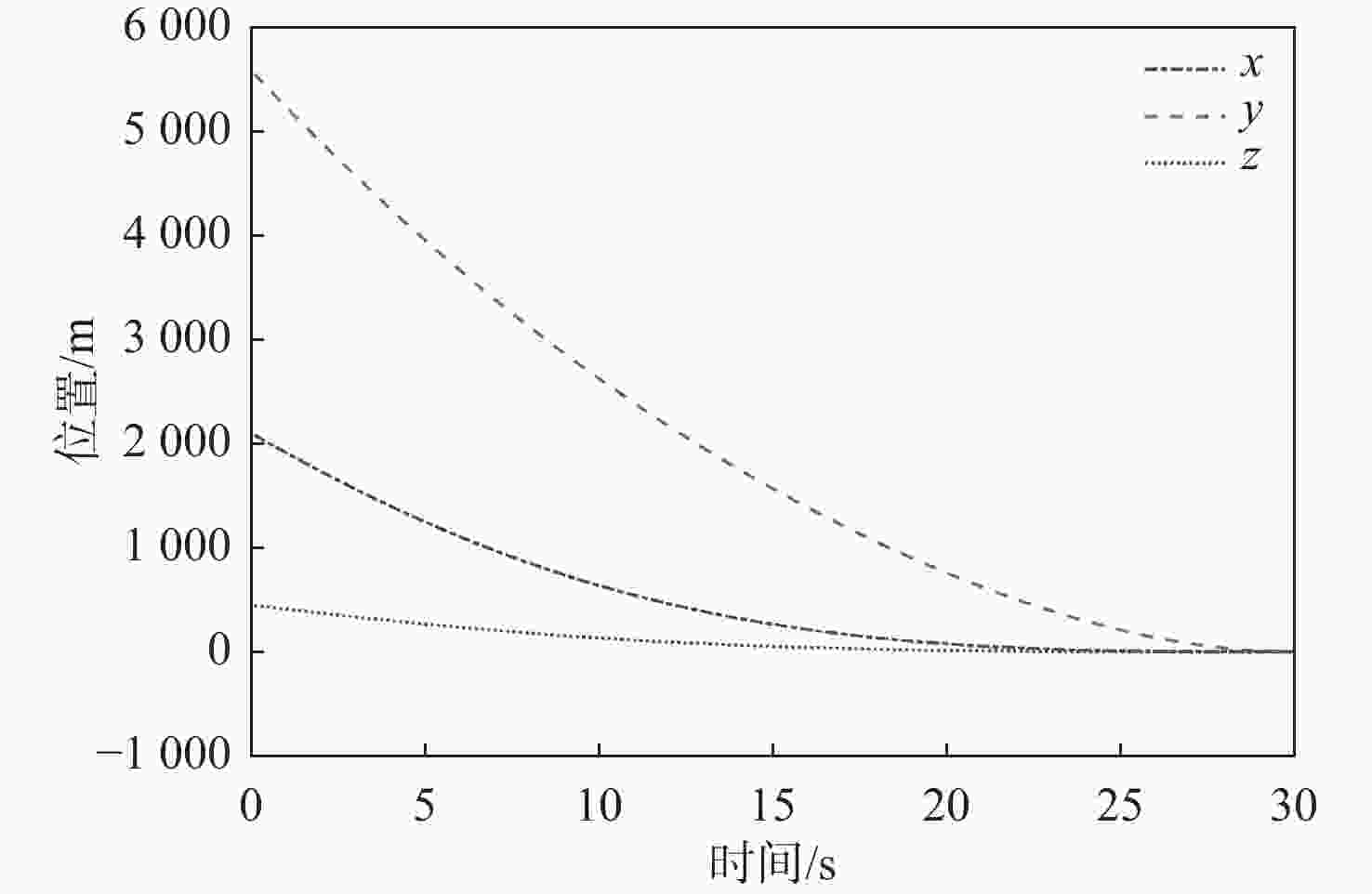
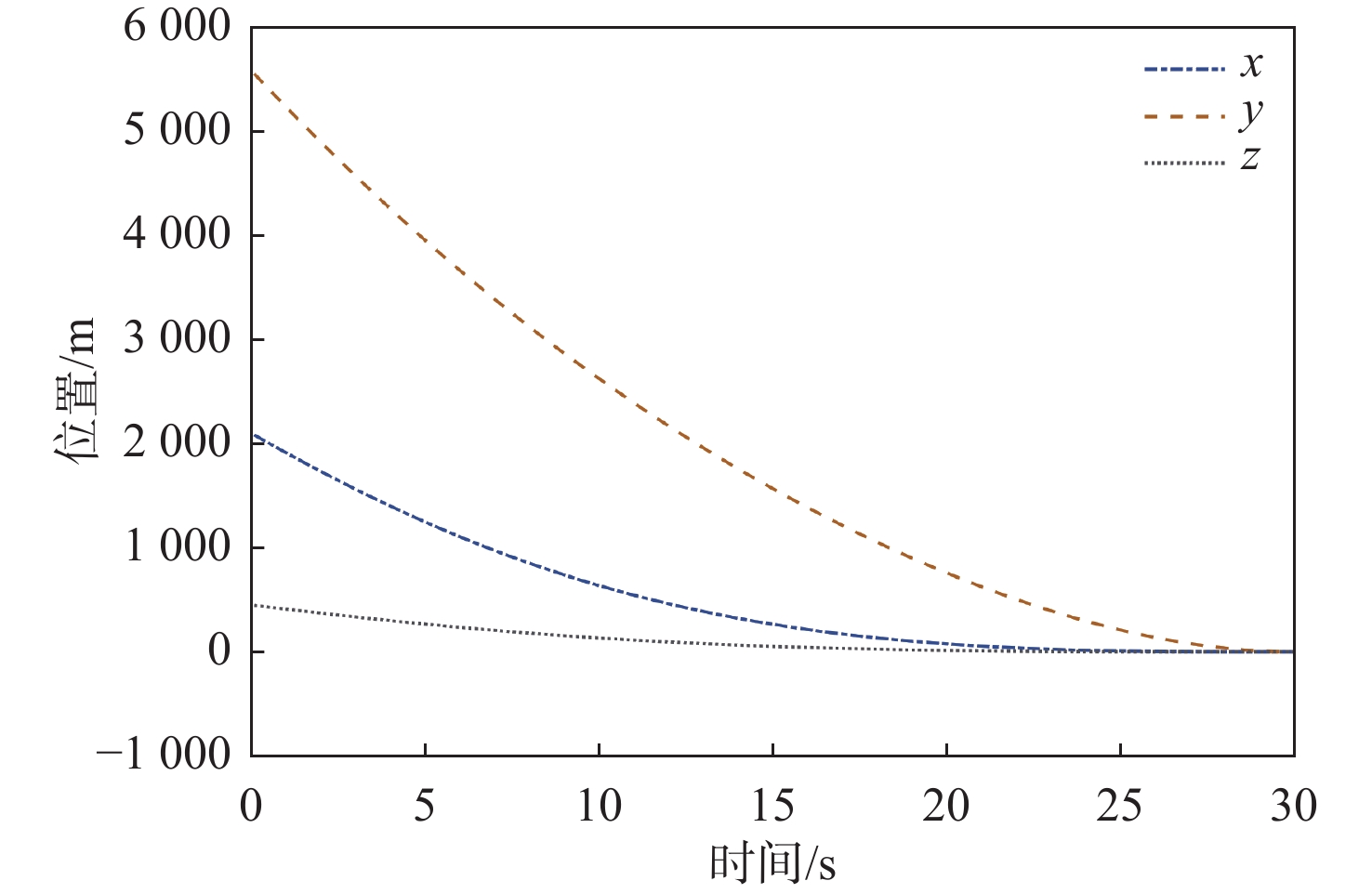
图 13 算例2基于UMPSP制导方法的火箭着陆段位置-时间曲线
Figure 13. Position-time curves of rocket landing phase based on UMPSP guidance method in example 2
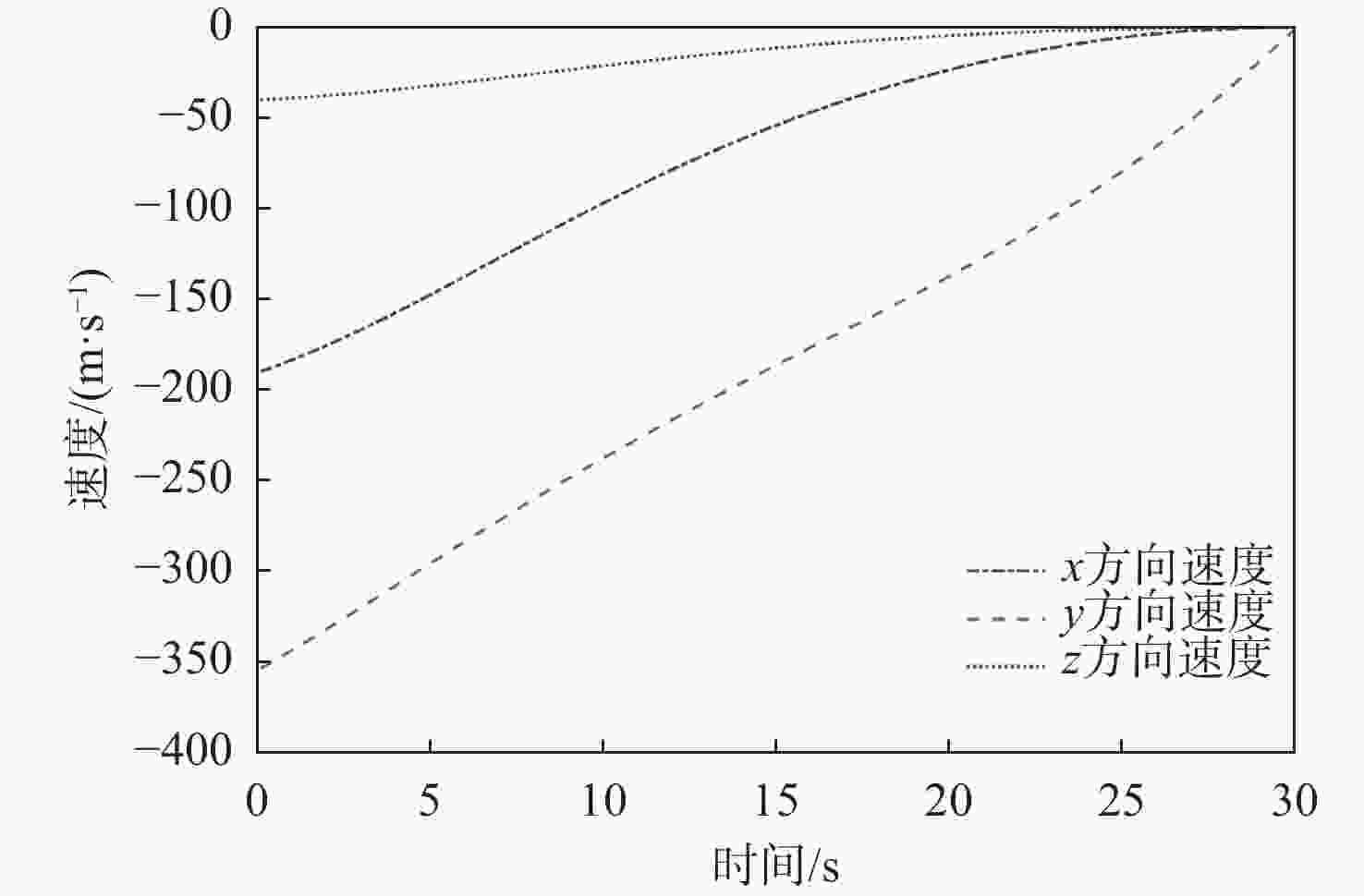
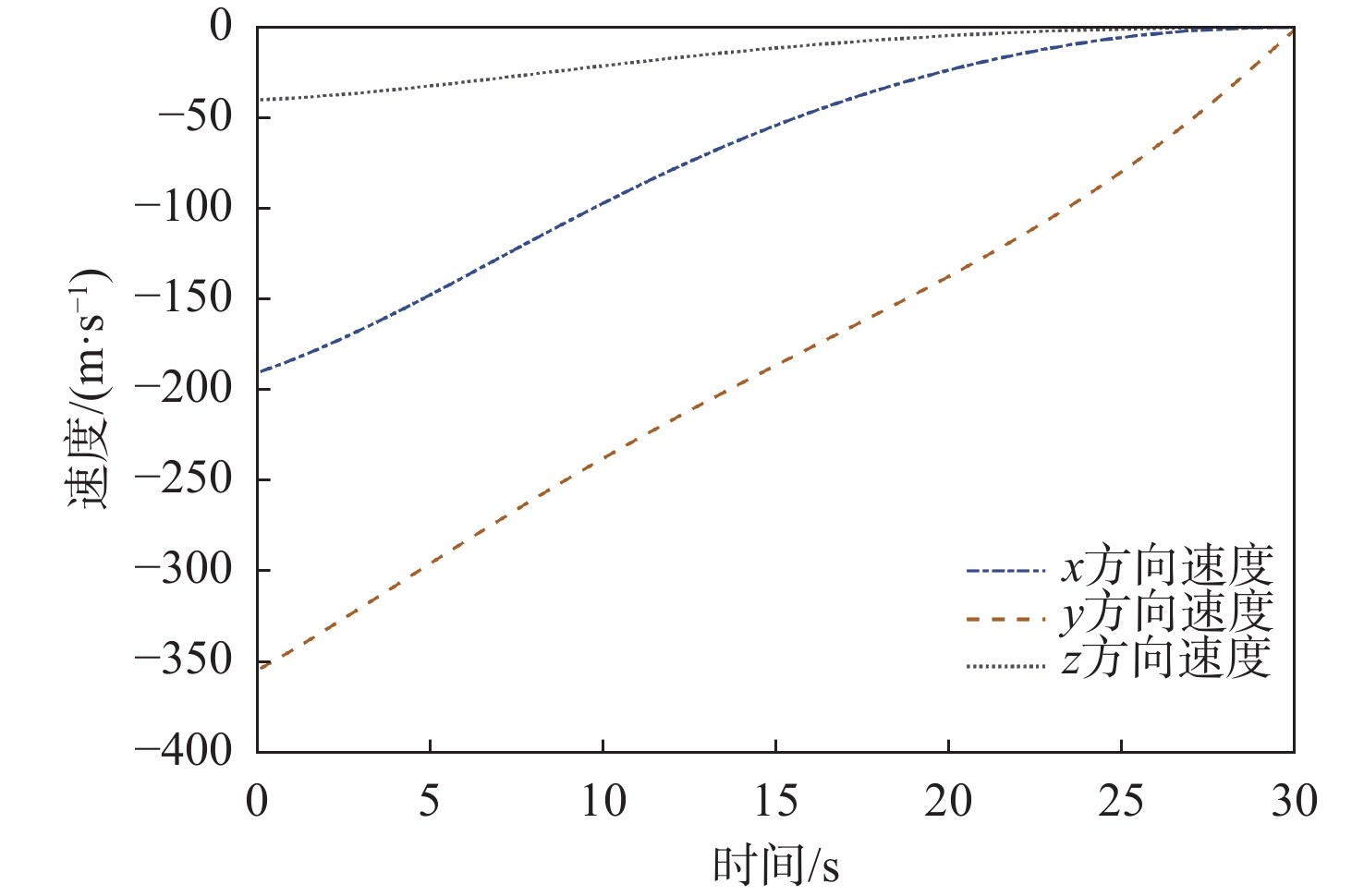
图 14 算例2基于UMPSP制导方法的火箭着陆段速度-时间曲线
Figure 14. Velocity-time curves of rocket landing phase based on UMPSP guidance method in example 2
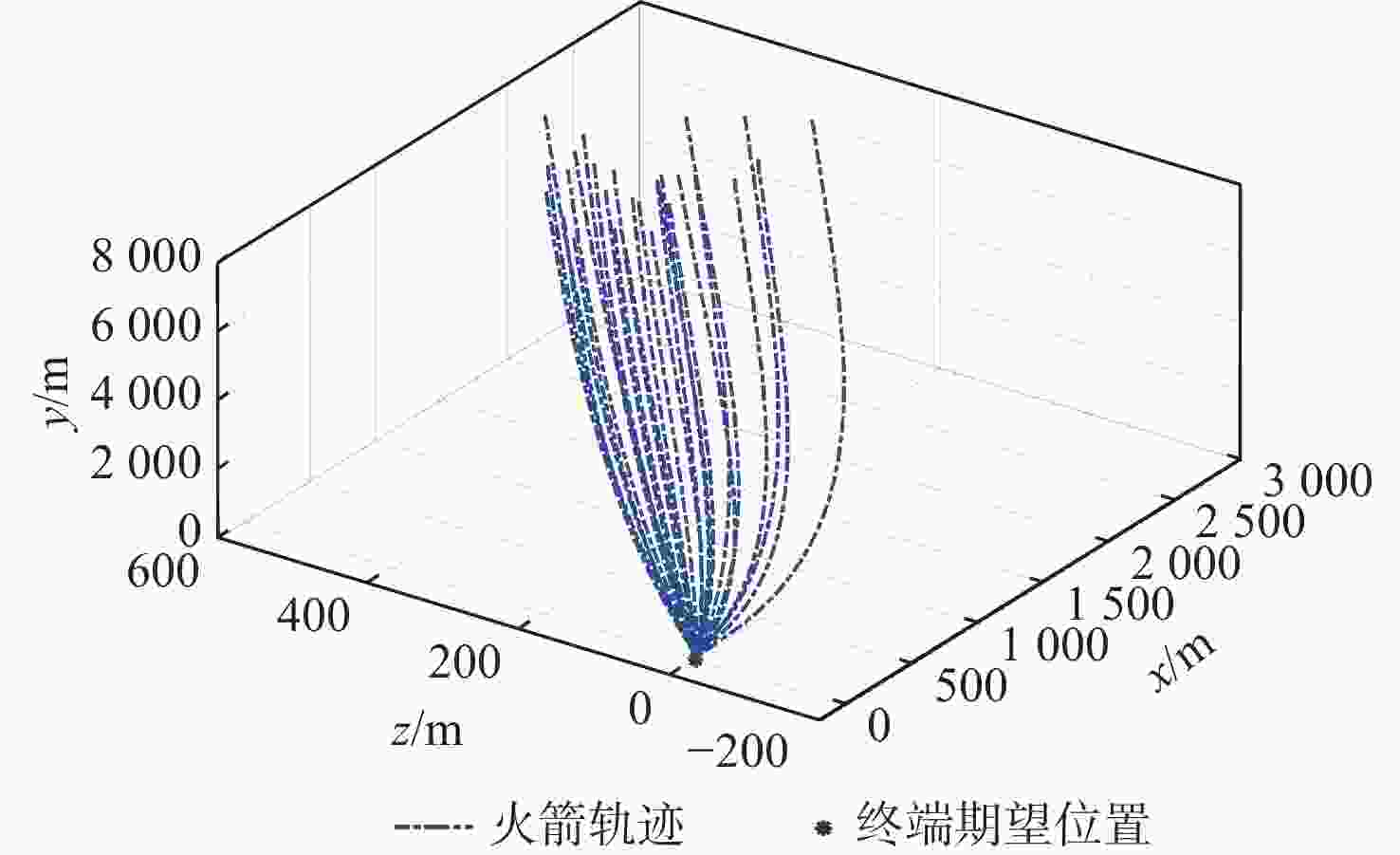
图 15 不同初始状态下火箭着陆段三维轨迹
Figure 15. 3D trajectory of rocket landing phase under different initial conditions
表 1 仿真参数值
Table 1. Simulation parameter values
最大推力/kN 发动机排气
速度/(m·s−1)火箭含燃料
总质量/kg火箭完全耗尽燃料
的总结构质量/kg火箭气动
参考面积/m2大气密度/
(kg·m−3)火箭阻力
系数终端收敛精度 845.2 2765.475 38963 27215 10.51 1.29 0.3 $ \left[2\;{\mathrm{m}},2\;{\mathrm{m}},2\;{\mathrm{m}},2\;{\mathrm{m/s}},2\;{\mathrm{m/s}},2\;{\mathrm{m/s}},1{^{\circ}},1{^{\circ}}\right] $  下载: 导出CSV
表 2 随机风场下终端偏差均值对比
Table 2. Comparison of mean terminal deviation under random wind fields
制导方法 终端位置偏差均值/m 终端速度偏差均值/(m·s−1) UMPSP 2.6652 0.0920 MPSP 4.0074 0.4782
下载: 导出CSV
表 3 随机风场下终端偏差标准差对比
Table 3. Comparison of standard terminal deviation under random wind fields
制导方法 终端位置偏差
标准差/m终端速度偏差
标准差/(m·s−1)UMPSP制导方法 2.0124 0.0729 MPSP制导方法 2.8204 0.0567
下载: 导出CSV
表 4 随机风场存在统计偏差下终端偏差均值对比
Table 4. Comparison of mean terminal deviation under statistical bias in random wind fields
制导方法 终端位置偏差均值/m 终端速度偏差均值/(m·s−1) UMPSP 3.0007 0.1066 MPSP 4.8022 0.4922
下载: 导出CSV
表 5 随机风场存在统计偏差下终端偏差标准差对比
Table 5. Comparison of standard terminal deviation under statistical bias in random wind fields
制导方法 终端位置偏差标准差/m 终端速度偏差标准差/(m·s−1) UMPSP 2.1348 0.0781 MPSP 3.2423 0.0621
下载: 导出CSV
表 6 基于UMPSP的制导方法与凸优化制导方法对比
Table 6. Comparison between UMPSP guidance method and convex optimization guidance approach
制导方法 算法收敛
时间/s终端位置
偏差/m终端速度
偏差/(m·s−1)UMPSP 2.41 1.264 0.543 凸优化[29] 6.72 0.451 12.137
下载: 导出CSV
表 7 蒙特卡罗仿真统计结果
Table 7. Monte Carlo simulation statistical results
统计量 终端位置/m 终端速度/(m·s−1) 终端姿态/(°) 迭代次数 均值 [0.523,0.790,0.117] [0.049,0.312,0.010] [90.018,0.001] 3.185 标准差 [2.652,0.849,0.926] [0.180,0.491,0.061] [0.056,0.013] 0.622
下载: 导出CSV
-
[1] Blackmore L. Autonomous precision landing of space rockets[C]//Proceedings of the Frontiers of engineering: reports on leading-edge engineering from the 2016 symposium. Washington, D. C. : The National Academies Press, 2016: 57-64. [2] 徐大富, 张哲, 吴克, 等. 垂直起降重复使用运载火箭发展趋势与关键技术研究进展[J]. 科学通报, 2016, 61(32): 3453-3463.Xu D F, Zhang Z, Wu K, et al. Recent progress on development trend and key technologies of vertical take-off vertical landing reusable launch vehicle[J]. Chinese Science Bulletin, 2016, 61(32): 3453-3463(in Chinese). [3] Klumpp A R. Apollo lunar descent guidance[J]. Automatica, 1974, 10(2): 133-146. [4] 张洪华, 关轶峰, 黄翔宇, 等. 嫦娥三号着陆器动力下降的制导导航与控制[J]. 中国科学(技术科学), 2014, 44(4): 377-384.Zhang H H, Guan Y F, Huang X Y, et al. Guidance navigation and control for Chang’E-3 powered descent[J]. Scientia Sinica (Technologica), 2014, 44(4): 377-384(in Chinese). [5] Mcinnes C R. Direct adaptive control for gravity-turn descent[J]. Journal of Guidance, Control, and Dynamics, 1999, 22(2): 373-375. [6] Zhou L Y, Xia Y Q. Improved ZEM/ZEV feedback guidance for Mars powered descent phase[J]. Advances in Space Research, 2014, 54(11): 2446-2455. [7] Acikmese B, Ploen S R. Convex programming approach to powered descent guidance for Mars landing[J]. Journal of Guidance, Control, and Dynamics, 2007, 30(5): 1353-1366. [8] Açıkmeşe B, Blackmore L. Lossless convexification of a class of optimal control problems with non-convex control constraints[J]. Automatica, 2011, 47(2): 341-347. [9] Szmuk M, Acikmese B, Berning A W. Successive convexification for fuel-optimal powered landing with aerodynamic drag and non-convex constraints[C]//Proceedings of the AIAA Guidance, Navigation, and Control Conference. Reston: AIAA, 2016: 0378. [10] 王劲博, 崔乃刚, 郭继峰, 等. 火箭返回着陆问题高精度快速轨迹优化算法[J]. 控制理论与应用, 2018, 35(3): 389-398.Wang J B, Cui N G, Guo J F, et al. High precision rapid trajectory optimization algorithm for launch vehicle landing[J]. Control Theory & Applications, 2018, 35(3): 389-398(in Chinese). [11] Szmuk M, Reynolds T P, Açıkmeşe B. Successive convexification for real-time six-degree-of-freedom powered descent guidance with state-triggered constraints[J]. Journal of Guidance, Control, and Dynamics, 2020, 43(8): 1399-1413. [12] Reynolds T P, Szmuk M, Malyuta D, et al. Dual quaternion-based powered descent guidance with state-triggered constraints[J]. Journal of Guidance, Control, and Dynamics, 2020, 43(9): 1584-1599. [13] 安泽, 熊芬芬, 梁卓楠. 基于偏置比例导引与凸优化的火箭垂直着陆制导[J]. 航空学报, 2020, 41(5): 242-255.An Z, Xiong F F, Liang Z N. Landing-phase guidance of rocket using bias proportional guidance and convex optimization[J]. Acta Aeronautica et Astronautica Sinica, 2020, 41(5): 242-255(in Chinese). [14] Padhi R, Kothari M. Model predictive static programming: a computationally efficient technique for suboptimal control design[J]. International Journal of Innovative Computing, Information and Control, 2009, 5(2): 399-411. [15] Maity A, Padhi R, Mallaram S, et al. A robust and high precision optimal explicit guidance scheme for solid motor propelled launch vehicles with thrust and drag uncertainty[J]. International Journal of Systems Science, 2016, 47(13): 3078-3097. [16] Sachan K, Padhi R. Waypoint constrained multi-phase optimal guidance of spacecraft for soft lunar landing[J]. Unmanned Systems, 2019, 7(2): 83-104. [17] Banerjee A, Padhi R, Vatsal V. Optimal guidance for accurate lunar soft landing with minimum fuel consumption using model predictive static programming[C]//Proceedings of the 2015 American Control Conference. Piscataway: IEEE Press, 2015: 1861-1866. [18] Wang Y, Topputo F. Robust Bang-off-Bang low-thrust guidance using model predictive static programming[J]. Acta Astronautica, 2020, 176: 357-370. [19] Maity A, Oza H B, Padhi R. Generalized model predictive static programming and angle-constrained guidance of air-to-ground missiles[J]. Journal of Guidance, Control, and Dynamics, 2014, 37(6): 1897-1913. [20] Mondal S, Padhi R. Constrained quasi-spectral MPSP with application to high-precision missile guidance with path constraints[J]. Journal of Dynamic Systems, Measurement, and Control, 2021, 143(3): 031001. [21] Wang X, Dai P, Cheng X M, et al. An online generation method of ascent trajectory based on feedforward neural networks[J]. Aerospace Science and Technology, 2022, 128: 107739. [22] Mathavaraj S, Padhi R. Unscented MPSP for optimal control of a class of uncertain nonlinear dynamic systems[J]. Journal of Dynamic Systems, Measurement, and Control, 2019, 141(6): 065001. [23] Mathavaraj S, Padhi R. Quasi-spectral unscented MPSP guidance for robust soft-landing on asteroid[J]. Journal of Optimization Theory and Applications, 2021, 191(2): 823-845. [24] Padhi R, Banerjee A, Mathavaraj S, et al. Computational guidance using model predictive static programming for challenging space missions: an introductory tutorial with example scenarios[J]. IEEE Control Systems Magazine, 2024, 44(2): 55-80. [25] Lu P, Callan R. Propellant-optimal powered descent guidance revisited[J]. Journal of Guidance, Control, and Dynamics, 2023, 46(2): 215-230. [26] 冯子鑫, 薛文超, 张冉, 等. 可回收火箭大气层内动力下降的多阶段鲁棒优化制导方法[J]. 自动化学报, 2024, 50(3): 505-517.Feng Z X, Xue W C, Zhang R, et al. A multi-stage robust optimization guidance method for endoatmospheric powered descent of reusable rockets[J]. Acta Automatica Sinica, 2024, 50(3): 505-517(in Chinese). [27] Halbe O, Raja R G, Padhi R. Robust reentry guidance of a reusable launch vehicle using model predictive static programming[J]. Journal of Guidance, Control, and Dynamics, 2014, 37(1): 134-148. [28] Simplício P, Marcos A, Bennani S. Guidance of reusable launchers: improving descent and landing performance[J]. Journal of Guidance, Control, and Dynamics, 2019, 42(10): 2206-2219. [29] 张志国, 马英, 耿光有, 等. 火箭垂直回收着陆段在线制导凸优化方法[J]. 弹道学报, 2017, 29(1): 9-16.Zhang Z G, Ma Y, Geng G Y, et al. Convex optimization method used in the landing-phase on-line guidance of rocket vertical recovery[J]. Journal of Ballistics, 2017, 29(1): 9-16(in Chinese). [30] 陈星伦, 张冉, 张晓燕. 大气层内动力下降段的组合干扰补偿制导[J]. 航空学报, 2023, 44(23): 156-171.Chen X L, Zhang R, Zhang X Y. Combined disturbance compensation guidance for powered descent in atmosphere[J]. Acta Aeronautica et Astronautica Sinica, 2023, 44(23): 156-171(in Chinese). -

 下载:

计量
- 文章访问数: 914
- HTML全文浏览量: 489
- PDF下载量: 178
- 被引次数: 0
