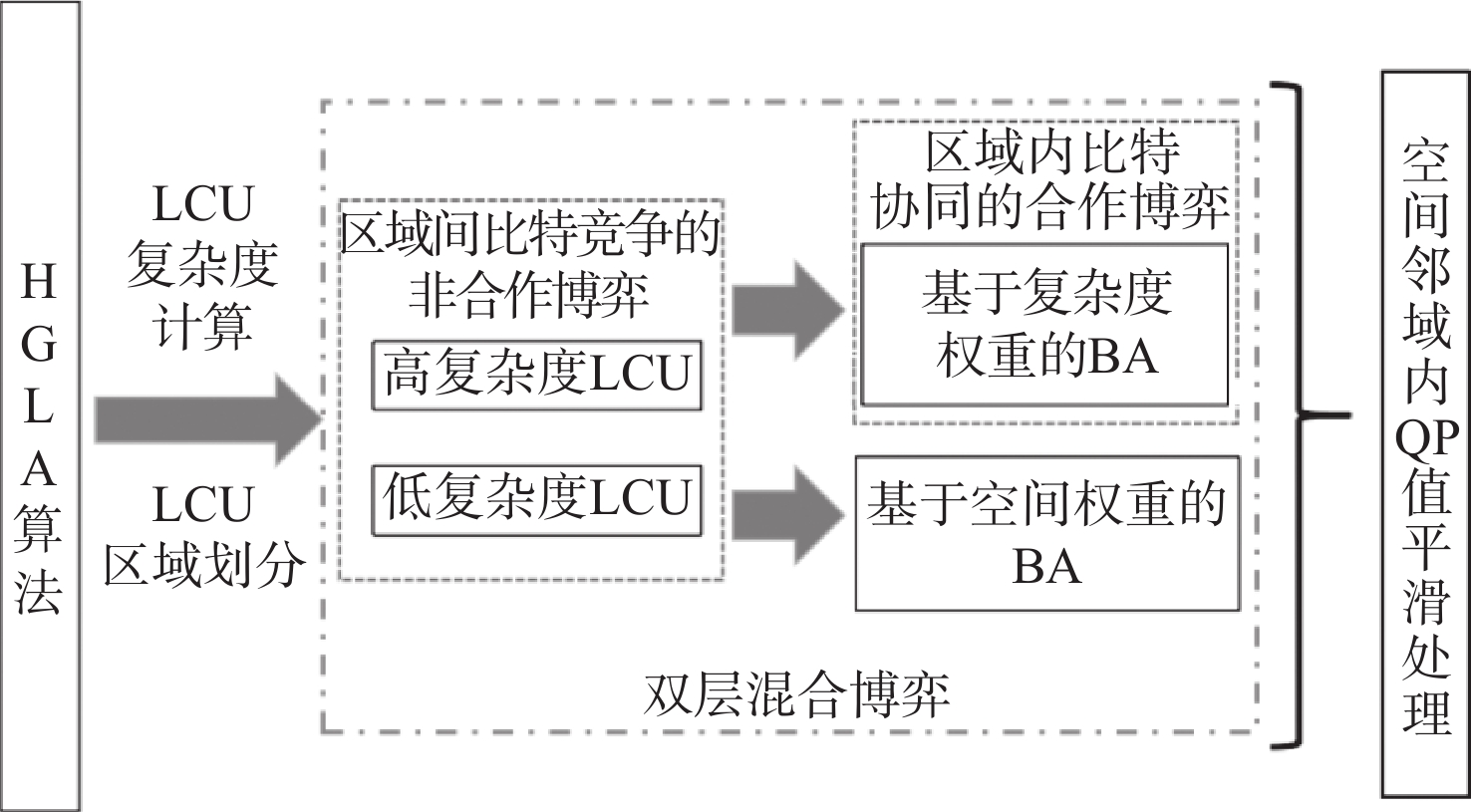
This paper addresses the issues of low video coding efficiency and insufficient bit rate utilization in low-altitude communication scenarios by proposing an largest coding unit (LCU)-level bit allocation (BA) optimization based on two-layer hybrid game model (HGLA) algorithm. Using the LCU as the basic unit, the algorithm performs region partitioning according to texture complexity, motion intensity, and edge information, and establishes a differentiated BA mechanism for high- and low-complexity regions. In particular, a combination of cooperative and non-cooperative game models is used for high-complexity regions to achieve coordinated BA; for low-complexity regions, a global quantization parameter (QP) smoothing strategy and a spatial weighting mechanism are introduced to improve bit rate utilization efficiency and visual continuity. Finally, experimental validation under four low-bit rate scenarios demonstrates that the proposed method achieves significant improvements in peak signal-to-noise ratio (PSNR), structural similarity index measure (SSIM), and subjective quality. Specifically, at the target bit rate of 16 Kbit/s, compared with four baseline methods including the high efficiency video coding (HEVC) rate control (RC) algorithm HM-RC and the frame-level multilayer perceptron (MLP)-based BA algorithm, the intra-frame rate control algorithm based on a simplified cubic rate-distortion model, and the variable-resolution rate control algorithm based on versatile video coding (VVC), the proposed method achieves average performance gains of 3.34%, 2.16%, and 9.8% in PSNR, SSIM, and mean opinion score (MOS), respectively, demonstrating its excellent practicality and adaptability in improving bit rate utilization efficiency and preserving image quality.




 Download (24751)
 Views
Views  Cited by

































 XML Online Production Platform